In heavy-duty fleet operations and industrial fluid transfer, dispensing equipment is often treated as a generic consumable. However, operations managers and procurement heads quickly discover that selecting the wrong dispensing hardware directly impacts operational profitability. Frequent spills, misfuelling, false shut-offs, and premature equipment failure lead to environmental compliance risks, degraded safety, and unacceptable dispensing downtime.
This industrial fuel nozzles buyer guide provides a consultative framework to help you match dispensing hardware to your specific operational conditions. By evaluating flow rates, material compatibility, cycle life, and safety interlocks, plant managers can standardize their fluid handling infrastructure, reduce maintenance overhead, and ensure seamless fleet management.
Quick ROI Snapshot
- Typical payback period: 6 to 8 months
- Primary savings driver: Elimination of overfill spills (saving up to 2% of total fuel inventory annually) and reduction in replacement frequency due to 1-million-cycle durability.
- Downtime reduction: Up to 40% fewer maintenance interventions compared to standard commercial-grade nozzles.
1. What Are Fuel Nozzles and What Do They Do?
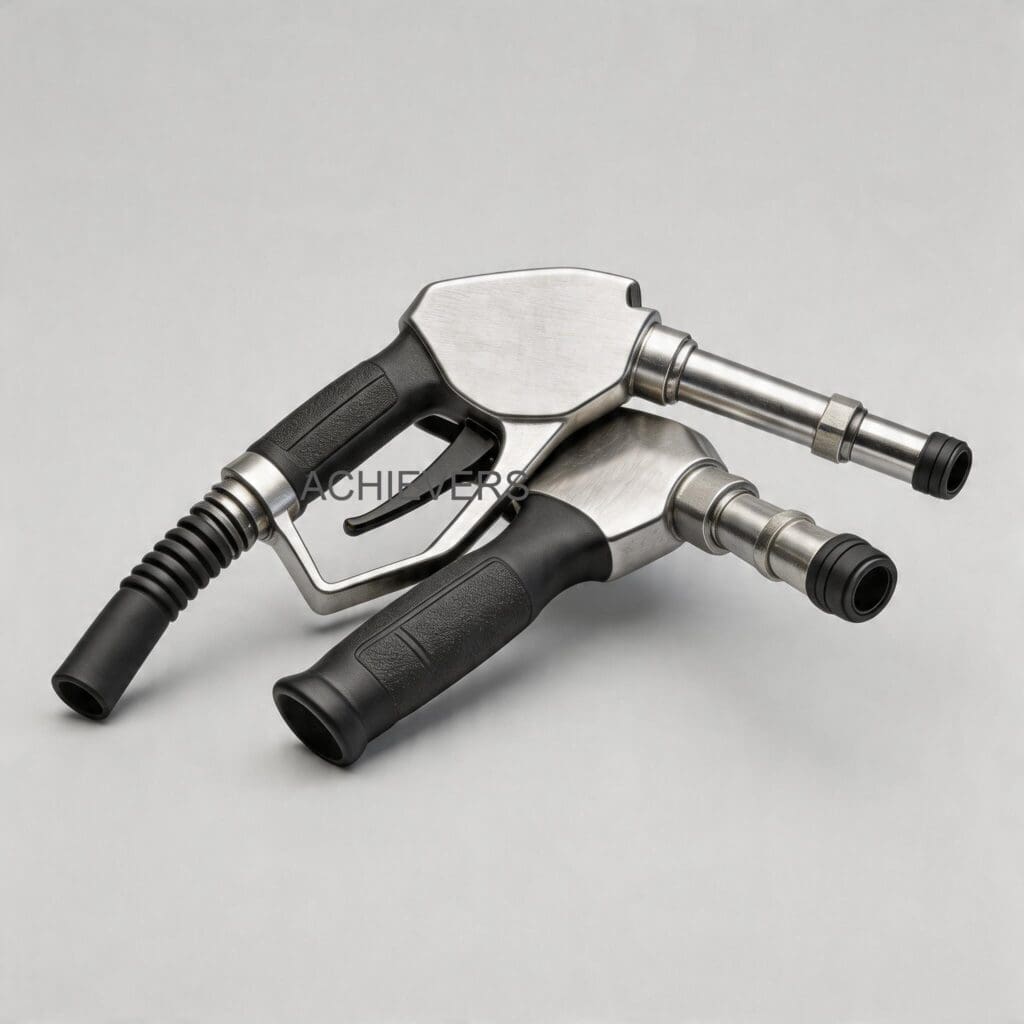
At its core, an industrial automatic fuel nozzle is a precision-engineered valve designed to regulate the transfer of volatile hydrocarbons from a storage or pumping system into a target receptacle. Unlike manual valves, an automatic Fuel Nozzles system utilizes fluid dynamics—specifically the Venturi effect—to detect changes in air pressure. When the fluid level covers the sensing port at the end of the spout, the vacuum changes, tripping a diaphragm that instantaneously shuts off the flow.
Achievers' advanced OPW 11b arrangement goes several steps further. Engineered for retail, commercial, and high-volume industrial filling applications (including prepay, self-serve, and card-lock systems), these units feature a unique "no-pressure, no-flow" interlock. The nozzle cannot be opened until the pumping system is actively pressurized, and it closes automatically the moment pressure is removed. This physically prevents accidental spills if a hose is dropped or a pump is deactivated.
Below is the foundational technical specification for our standard industrial automatic nozzle:
| Specification | Value | Engineering Notes |
| :— | :— | :— |
| Inlet Thread | BSP 3/4" | Standard British Standard Pipe thread for global industrial hose compatibility. |
| Spout Diameter | 13/16" | Optimized for standard vehicle and machinery tank fill points. |
| Flow Rate | 0 – 60 L/min | Ideal for light-to-medium fleet commercial dispensing. |
| Operating Pressure | 0.18 MPa (1.8 Bar) | Supports standard dispensing pump pressures without seal degradation. |
| Cycle Life | > 1,000,000 cycles | Rigorously cycle-verified; far exceeds the commercial standard of 250,000 cycles. |
| Spout Material | Stainless Steel | Lasts up to four times longer than standard aluminum spouts against friction and impact. |
| Net Weight | 1.14 kg/pc | Balances heavy-duty internal valving with operator ergonomics. |
| Compatibility | Diesel, Petrol, Ethanol Mixes | Rated for up to 10% ethanol blends safely. |
2. Key Selection Criteria for Global Industrial Buyers
When determining how to choose fuel nozzles for industrial dispensing, procurement teams must look beyond basic dimensions. A nozzle deployed in a highly corrosive chemical plant environment requires different specifications than one used at a sub-zero mining facility or a high-throughput logistics hub.
Flow Rate and Pressure Dynamics
The most critical factor is matching the nozzle's flow capacity to the pump's output. A 0-60 L/min capacity is ideal for standard fleet vehicles, light machinery, and commercial vehicles. If you force a high-flow pump (e.g., 120 L/min) through a 60 L/min nozzle, you will create excessive back-pressure, fluid turbulence, and foaming. Foaming causes the automatic shut-off sensor to trigger prematurely, forcing the operator to continually re-engage the lever, which drastically slows down the refueling process.
Material Selection and Fluid Compatibility
Standard automatic fuel nozzle specifications for diesel and petrol require specific internal seals (such as Viton or specialized Buna-N) to prevent degradation from the hydrocarbons. Furthermore, modern fuels often contain additives or ethanol. Achievers Fuel Nozzles are specifically rated for up to 10% ethanol blends. Externally, standard aluminum spouts wear down quickly from the repeated friction of being inserted into metal tank necks. Upgrading to a stainless steel spout ensures the tip lasts up to four times longer, maintaining the integrity of the critical vacuum sensing port.
Shut-Off Reliability and Safety Interlocks
In unmanned or card-lock fleet fueling stations, operators are prone to human error. A "no-pressure, no-flow" device is an essential safety feature. It ensures that if an operator props the nozzle open and the pump shuts off, the nozzle valve physically closes. When the next user turns the pump on, fuel will not instantly spray out of the nozzle. Furthermore, a blocker on the lever guard prevents users from jamming the nozzle in an open position using external objects, enforcing safe dispensing practices.
Ergonomics and Operator Fatigue
In industrial settings where operators may dispense thousands of liters per shift, physical ergonomics matter. The combination of a lightweight design (1.14 kg), an attractive 2-piece hand protector, and a hold-open clip spring reduces hand strain. Additionally, Accu-stop "to-the-penny" flow control technology allows operators to feather the flow precisely when topping off tanks, preventing minor surface spills that require expensive hazardous material cleanup.
Common Mistake to Avoid
Mismatching Flow Rates and Spout Sizes: A frequent procurement error is purchasing a heavy-duty high-flow pump but pairing it with a standard 3/4-inch, 60 L/min nozzle. This bottleneck causes extreme pressure drops, fuel foaming, and continuous false shut-offs. Always ensure your pump's maximum flow rate aligns perfectly with the nozzle's specified flow range.
3. Model and Variant Comparison
Standardizing your fluid transfer systems across a facility often requires matching different nozzle variants to specific applications. While the core OPW 11b arrangement remains a benchmark, integrating measurement and specific fluid profiles can optimize operations.
Below is a comparison of typical industrial nozzle configurations to help you select the best fuel nozzles for fleet fueling stations and process plants.
| Configuration | Flow Range | Primary Feature | Best Suited For | Integration Capability |
| :— | :— | :— | :— | :— |
| Standard Automatic Nozzle | 0 – 60 L/min | No-pressure, no-flow safety interlock | General fleet management, petrol and diesel retail. | Standalone dispensers |
| Diesel Nozzle with Flow Meter | 20 – 80 L/min | Integrated mechanical or digital volumetric tracking | Remote mining sites or agriculture where centralized tracking is unavailable. | Direct hose attachment |
| High-Flow Auto Nozzle | Up to 120 L/min | 1-inch inlet, heavy-duty valving | Heavy mining equipment, bulk logistics trucks, rail. | Bulk loading arms |
| AdBlue / DEF Nozzle | 0 – 40 L/min | Stainless steel / specialized polymer internals | Modern diesel fleets requiring urea dispensing. | Chemical transfer setups |
Note: For operations requiring precise centralized fluid tracking across multiple dispensing points, we recommend pairing standard nozzles with a dedicated Fuel Flow Meter installed at the dispenser level.
4. Common Mistakes Operators Make When Choosing
Even experienced plant managers can make sub-optimal purchasing decisions if they treat all dispensing hardware as identical. Whether you are sourcing from a distributor in Europe or a fuel nozzles supplier in India, avoiding these technical pitfalls will protect your equipment lifespan and site safety.
- Ignoring Cycle Life Specifications: Standard commercial nozzles are typically rated for 250,000 to 500,000 cycles. In a busy industrial environment, this can mean replacing nozzles annually. Failing to specify a 1-million-cycle verified nozzle results in unnecessary maintenance downtime and higher total cost of ownership.
- Overlooking Drop and Impact Resistance: Operators drop nozzles on concrete constantly. Choosing nozzles with rigid, brittle aluminum bodies or lacking lever protection leads to structural cracks. Look for products featuring "duratuff" lever guards that absorb impact and won't scratch user vehicles.
- Failing to Verify Chemical Compatibility: Assuming a standard diesel nozzle can handle high-concentration biofuels, aviation fuels, or aggressive solvents will lead to rapid O-ring swelling and internal seal failure. Always verify the maximum ethanol or biodiesel percentage allowable.
- Bypassing Card-Lock Safety Features: Buying basic agricultural nozzles for automated card-lock systems is a major hazard. Without the no-pressure, no-flow mechanism, a user pulling the trigger before authorizing the pump—and leaving it locked open—will cause a massive spill once the system finally activates.
- Using High-Flow Nozzles on Passenger Vehicles: Attempting to speed up dispensing by fitting a 1-inch, 120 L/min nozzle onto a light-duty fleet dispenser causes the fuel to back up in the narrow vehicle fill pipe, causing immediate splash-back and hazardous skin exposure for the operator.
5. Standardizing Your Procurement: 8-Step Specification Checklist
To streamline your procurement process and ensure you receive the exact hardware required for your application, use this actionable checklist when submitting an enquiry to your dispensing equipment manufacturer.
- Determine the Target Flow Rate: Calculate the output of your existing dispensing pumps. Specify the required nozzle flow range (e.g., 0-60 L/min for standard, >100 L/min for bulk).
- Identify the Fluid Handled: Explicitly list the fluid—petrol, diesel, aviation fuel, AdBlue, or chemical blends—including any additive percentages (e.g., 10% ethanol).
- Confirm Hose Connection Threads: Verify the thread type and size of your current hoses (e.g., BSP 3/4", NPT 1", BSPP). Mismatched threads require adapters, which create potential leak points.
- Specify Spout Dimensions: Check the standard receptacle sizes of your fleet. Ensure the spout diameter (e.g., 13/16") will comfortably fit without restricting displaced air.
- Mandate Safety Interlocks: For self-serve or automated systems, explicitly require a "no-pressure, no-flow" mechanism and an attitude sensor (which shuts off flow if the nozzle points upwards).
- Select Body and Spout Materials: Demand a stainless steel spout tip for heavy-duty applications to resist abrasion, and specify duratuff or high-impact polymer for the hand guards.
- Evaluate Ergonomic Add-ons: Request Accu-stop technology for precision flow control and hold-open clips if local regulations permit them.
- Define Integration Requirements: If mobile dispensing is required, note whether these nozzles will be integrated into a Mobile Fuel Dispenser setup, which may dictate specific weight or drop-resistance tolerances.
FAQ
Q: What does the "no-pressure, no-flow" feature actually do?
A: It is a safety interlock that prevents the nozzle valve from opening unless it senses active pressure from the fuel pump. If the pump turns off, the nozzle shuts automatically, preventing spills if the lever is accidentally left in the open position.
Q: Can I use this nozzle for aviation fuel or aggressive chemicals?
A: The standard Achievers nozzle is optimized for petrol, diesel, and up to 10% ethanol mixes. Aviation fuels and aggressive solvents require different internal elastomers (like Teflon or specific Kalrez blends) and specialized ATEX certifications. Always consult with us for specialty fluid applications.
Q: Why does my automatic nozzle keep shutting off prematurely?
A: Premature shut-off is usually caused by excessive pump flow creating fuel foaming, a blocked air-sensing port at the tip of the spout, or a mismatch between the spout diameter and the vehicle’s fill pipe, which causes fluid to splash back against the sensor.
Q: What is the advantage of a stainless steel spout over an aluminum one?
A: Industrial operators frequently insert and remove the nozzle against metal tank edges. Aluminum is relatively soft and wears down over time, potentially damaging the internal vacuum tube. Stainless steel is highly durable and lasts up to four times longer under heavy abrasion.
Q: Is it difficult to replace the spout or seals on site?
A: While external components like the duratuff lever guards are easily replaceable, we recommend replacing the entire unit if internal valving fails. Disassembling the core pressure seals on site can compromise the automatic shut-off safety mechanisms and void cycle-life warranties.
Q: How often should industrial fuel nozzles be inspected?
A: Daily visual inspections should be conducted for external cracks, leaks at the swivel joint, and blockages in the spout tip. A comprehensive functional test of the automatic shut-off mechanism should be performed monthly to ensure environmental compliance.
Q: What does the cycle rating of 1,000,000 mean for my operations?
A: A cycle is defined as one complete opening and closing of the main valve. A 1-million cycle rating indicates extreme internal durability. For a busy logistics yard dispensing fuel 200 times a day, this nozzle is engineered to physically outlast standard commercial alternatives by several years.
Ready to eliminate fuel spills and reduce dispensing downtime across your facility? Contact the engineering team at Achievers Pumps and Valves today with your required flow rate, fluid type, and dispenser connection specifications. We will help you configure the exact dispensing solution to protect your personnel and optimize your operations.