For Indian logistics parks and third-party logistics (3PL) providers, diesel is not just a consumable; it is one of the largest controllable operating expenses. When you manage a fleet depot processing anywhere from 50 to 500 vehicle movements a day, the speed and accuracy of your fuel issuing directly impact your bottom line. Unfortunately, many transport hubs still rely on generic gravity-fed storage tanks, uncalibrated drum pumps, or outdated bypass-valve systems. These makeshift setups lead to a triad of operational headaches: long vehicle queues during shift changes, manual entry errors in logbooks, and worst of all, untraceable diesel pilferage.
To turn your fuel island from a cost-leakage point into a strictly controlled asset, you need an engineered dispensing system designed specifically for high-volume commercial use. Implementing a dedicated Diesel Dispenser allows operations managers to automate batch issuing, eliminate manual measurement errors, and secure fuel stocks against unauthorized access. This guide breaks down how fleet operators can leverage advanced dispensing technology to streamline depot workflows, maintain stringent accountability, and ensure every drop of diesel is properly utilized.
1. Industry Overview: The Fluid Challenge
A standard Indian logistics yard operates under demanding environmental and operational conditions. During peak outbound hours, dozens of heavy commercial vehicles (HCVs) may require refueling simultaneously. When using standard low-flow pumps, it can take up to 20 minutes to fill a large saddle tank, causing severe bottlenecks. Furthermore, depot environments are harsh—exposed to heavy dust in summer, extreme humidity during the monsoons, and notorious voltage fluctuations that can fry sensitive imported electronics.
Beyond environmental challenges, the core issue is fuel security. Without a tamper-proof metering system, small quantities of diesel (5 to 10 liters per transaction) are easily skimmed. Over a month, this pilferage can easily translate to lakhs of rupees in lost revenue. A robust diesel dispenser for logistics hub fuel issuing must bridge the gap between heavy-duty mechanical reliability and high-precision electronic tracking. It must comply with Indian regulations, specifically Legal Metrology guidelines, to ensure that internal fuel transfers are legally auditable and dispute-free.
2. Product Capabilities Matched to Industry Needs
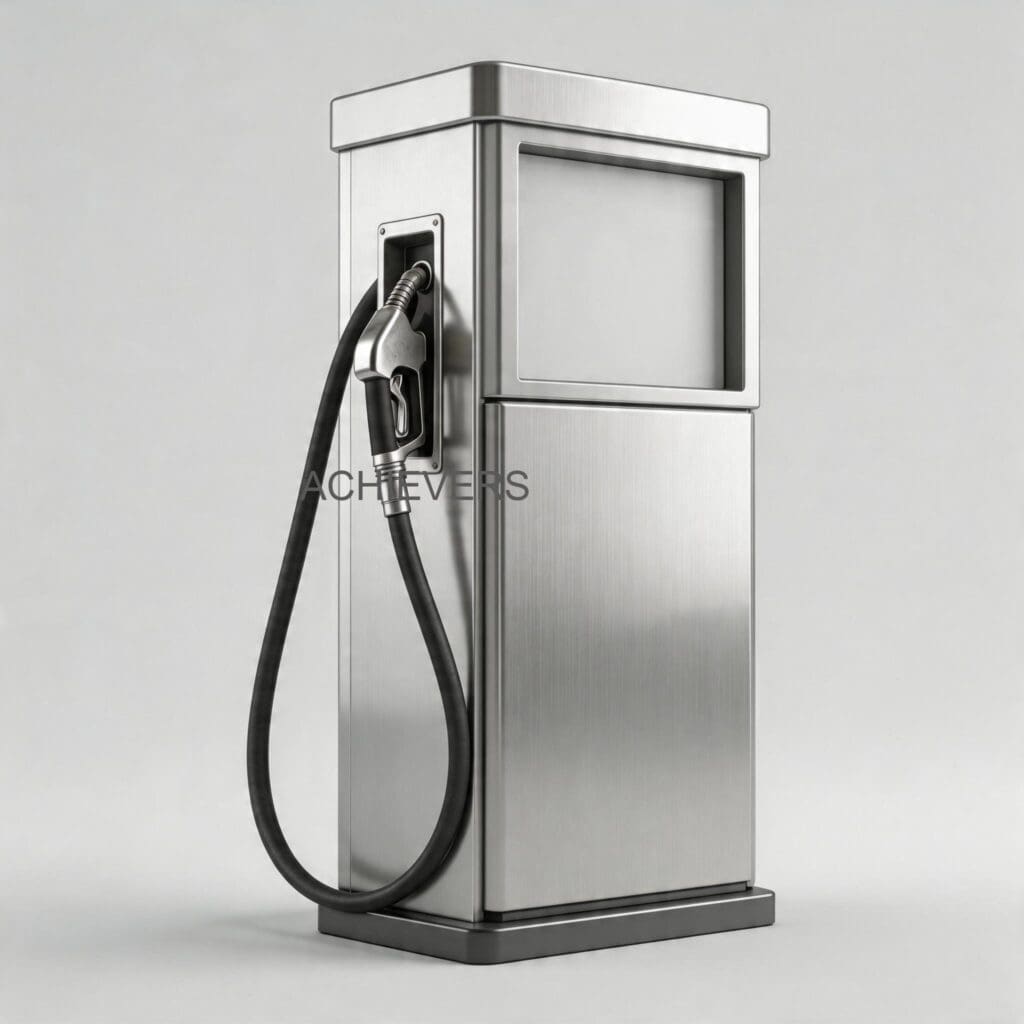
Generic pumps fail in logistics hubs because they lack integrated flow measurement and batch control. A true industrial diesel dispensing solution for 3PL yards combines a motorized pump, a high-precision flow meter, and an electronic preset controller into a single, skid-mountable unit.
| Industry Requirement | Diesel Dispenser Feature | How It Addresses the Need |
| :— | :— | :— |
| High-Speed Turnaround | 20-60 L/min Flow Rate | Fills standard commercial vehicle tanks rapidly, cutting driver wait times and reducing yard congestion during peak shift changes. |
| Custody Transfer Accuracy | ±0.5% Precision Measurement | Ensures fuel logs match actual inventory. Critical for eliminating the "unaccounted losses" typical in manual drum dispensing. |
| Tamper-Proof Auditing | 9-Digit Volume / 11-Digit Amount Totalizer | The massive digit capacity makes it virtually impossible to roll over or reset unnoticed, providing a hard, permanent audit trail for management. |
| Automated Fuel Issuing | Electronic Preset Function (Volume/Amount) | Operators punch in exactly "200 Liters". The pump automatically shuts off when the target is reached, preventing expensive overfills. |
| Power Unreliability Adaptability | AC 220V and DC 12V/24V Options | Can be hardwired to the depot's main grid or run off vehicle batteries, ensuring fuel operations continue even during grid power cuts. |
| Regulatory Compliance | Weights and Measures Approved | Certified by the Govt. of India Legal Metrology department, making it legally valid for internal accounting and sub-contractor billing. |
| Harsh Environment Durability | Robust Enclosure & 4m Rubber Hose | Built to withstand Indian depot dust and monsoon moisture. The 4m hose easily reaches awkward tank configurations without moving the rig. |
| Standardized Connections | 25mm (1-inch) Inlet/Outlet | Standard industrial sizing ensures easy integration with existing bulk storage tanks without requiring complex, flow-restricting adapters. |
3. Typical Installation Scenarios in This Industry
Logistics companies operate in varied configurations, from permanent central hubs to remote mining outposts. The versatility of a modern dispenser allows it to be deployed in three primary ways:
Centralized Yard Fuel Islands (Static Setup)
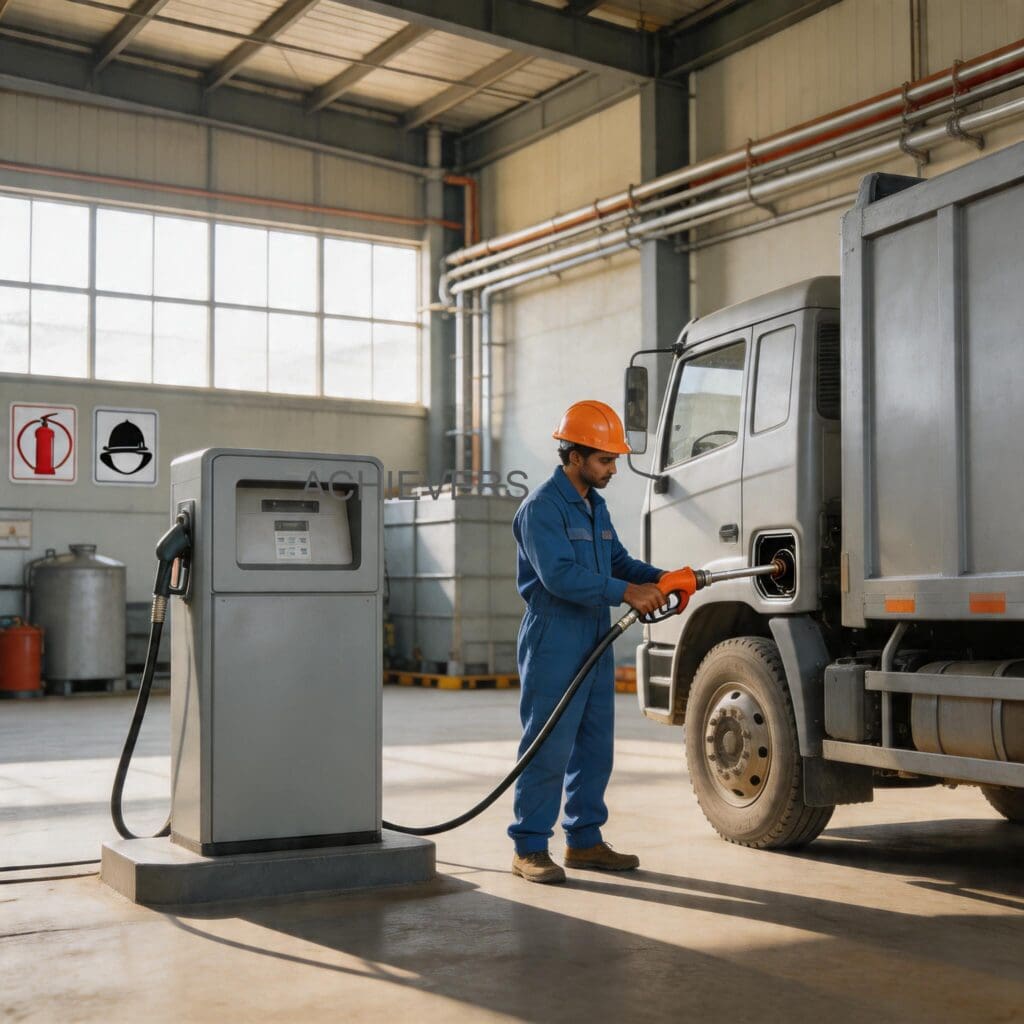
For permanent 3PL hubs, the dispenser is typically mounted on a raised concrete pedestal adjacent to an underground or above-ground bulk storage tank. Powered by the site's AC 220V grid (backed by the facility's DG set), this setup provides a dedicated "fuel station" experience for fleet drivers. The 20-60 L/min flow rate easily handles high daily throughput, while the electronic preset function allows night-shift security personnel to issue exact fuel quotas safely.
Mobile Refueling Bowsers
For large construction yards, mining sites, or expansive port logistics parks, bringing the truck to the pump is inefficient. Instead, operators mount a DC 12V or 24V dispenser directly onto a mobile tank truck (bowser). This essentially creates a highly accurate Mobile Fuel Dispenser that travels from vehicle to vehicle. The dispenser runs directly off the bowser truck's battery, dispensing diesel directly into parked excavators, cranes, or transport trucks, completely eliminating idle transit time.
Automated Night-Shift Issuing
Many transport fleets dispatch vehicles between 10:00 PM and 4:00 AM. Staffing a fuel island with senior supervisors overnight is costly. By installing a preset-enabled dispenser, management can issue a nightly fuel manifesto. The night operator simply enters the required volume per truck. The machine handles the exact metering and auto-shutoff, leaving no room for "accidental" over-dispensing or manual ledger manipulation.
4. Compliance, Accuracy, and Certification Requirements
When you buy diesel dispenser with preset meter and legal metrology approval, you are protecting your business legally and financially. In India, any device used to measure fuel for commercial transactions, sub-contractor billing, or strict internal auditing must be certified by the Legal Metrology Department (Govt. of India).
Unapproved flow meters are illegal to use for commercial accounting and leave transport companies vulnerable during tax audits or sub-contractor disputes over fuel deductions. A certified dispenser operating at ±0.5% accuracy guarantees that if the meter reads 1,000 liters dispensed, the actual volume transferred is between 995 and 1,005 liters. This level of precision is mandatory when reconciling expensive diesel inventories against monthly fuel bills. Additionally, the equipment's robust design aligns with general safety requirements for handling Class B petroleum products (diesel), keeping your operations compliant with basic safety protocols.
5. ROI and Operational Benefits
Investing in engineered dispensing equipment pays for itself rapidly by plugging the invisible leaks in your operational budget.
Quick ROI Snapshot: Fleet Depot Fuel Upgrades
- Typical upfront investment: ₹40,000 – ₹85,000 (depending on AC/DC configuration, structural mounts, and extended warranties).
- Pilferage reduction: Historically saves 3% to 5% of total monthly diesel throughput.
- Time savings: Reduces refueling time by up to 40% per vehicle compared to standard drum pumps.
- Typical payback period: 3 to 6 months (for a 50-truck yard dispensing 15,000+ liters/month).
Beyond fuel savings, the operational benefits include massive reductions in administrative time. Accounting teams no longer have to decipher grease-stained logbooks; they simply audit the 11-digit electronic totalizer against daily dispatch sheets.
6. Implementation Procedure: Standardizing Fleet Fueling
To get the most out of your Diesel Dispenser, you must pair the hardware with strict standard operating procedures (SOPs). Follow this 7-step implementation process to secure your depot's fuel issuing:
- Site Evaluation and Power Routing: Determine if your yard requires a static AC 220V setup or a mobile DC 12V/24V setup. Ensure a dedicated, voltage-stabilized power line is available for static units to protect the internal electronics from grid spikes.
- Secure Mounting: Bolt the dispenser unit securely to a concrete island or the chassis of your mobile bowser. Ensure the 25mm inlet pipe is connected to the bulk tank with a high-quality, leak-proof flange and an inline Y-strainer to catch tank sludge.
- Initial Priming and Air Purging: Before first use, prime the pump and run a few liters of diesel through the system back into a calibrated bucket to purge any airlocks from the 4m rubber hose. Air bubbles can temporarily skew flow meter accuracy.
- Calibration Verification: Dispense exactly 20 liters into a Legal Metrology-certified conical measure. Verify that the dispenser's digital readout matches the physical volume. (This should be done monthly).
- Establish Preset Workflows: Ban manual continuous dispensing. Train operators to always use the keypad to input the exact volume (e.g., 150 liters) or monetary amount authorized on the driver's job card before pulling the nozzle trigger.
- End-of-Shift Audits: At the close of every shift, the yard supervisor must record the unalterable 9-digit volume totalizer reading. The difference between the morning and evening totalizer must perfectly match the sum of all job cards.
- Scheduled Maintenance: Schedule a filter cleaning and hose inspection every 30 days. Hard water, dust, and contaminated fuel can wear down components if basic housekeeping is ignored.
7. Selection Checklist for This Industry
Finding the right diesel dispenser supplier for logistics and transport companies means asking the right technical questions. Use this checklist when specifying your equipment:
- Power Supply Compatibility: Does your yard require AC 220V (static) or DC 12V/24V (mobile bowser)?
- Flow Rate Profiling: Is the 20-60 L/min range sufficient for your tank sizes? (Ideal for tanks up to 500 liters; ensures fast fills without excessive foaming).
- Legal Metrology Approval: Does the vendor provide Weights and Measures certification documentation?
- Preset Functionality: Does the keypad allow for both Volume (Liters) and Amount (Rupees) presetting?
- Totalizer Capacity: Are the totalizers sufficiently large? (Demand 9 digits for volume and 11 digits for amount to prevent rollover tampering).
- Hose and Nozzle Quality: Is the supplied hose at least 4 meters long? Is it constructed of diesel-resistant, anti-static rubber?
- Filtration Readiness: Does the system accommodate inline filtration to protect the meter from Indian fuel adulteration or tank rust?
- After-Sales Support: Does the supplier offer a 1-year baseline warranty with options for a 2-year extended warranty?
Common Mistake to Avoid
Purchasing standard "transfer pumps" instead of "dispensers." A transfer pump only moves fluid; it does not accurately measure it or stop automatically. Using transfer pumps with aftermarket mechanical meters in a high-volume fleet depot inevitably leads to calibration drift, overfills, and zero accountability. Always specify a fully integrated dispenser with an electronic preset.
FAQ
Q: Is the Legal Metrology certificate valid across all states in India?
A: Yes, Weights and Measures approvals granted by the central Legal Metrology department are valid nationwide. However, you must ensure the initial stamping is done as per local state jurisdiction guidelines upon installation.
Q: How does the system handle the severe voltage fluctuations common in Indian industrial estates?
A: The internal electronics are designed with baseline tolerance for standard industrial power. However, for static AC 220V installations in areas with heavy voltage spikes, we strongly recommend wiring the dispenser through a standard voltage stabilizer or UPS to protect the preset control board.
Q: What maintenance is required to maintain the ±0.5% accuracy over time?
A: Accuracy relies on a clean fluid stream. The most critical maintenance is routinely cleaning the external inline Y-strainer or filter connected to your bulk tank. Keeping rust, sludge, and debris out of the meter's internal measurement chamber ensures long-term precision.
Q: Can a DC 24V variant be run continuously all day on a mobile bowser?
A: DC motors are highly robust but do generate heat. While they can handle high-frequency batching, it is standard engineering practice to allow the motor a brief cooling cycle after 30-40 minutes of continuous, uninterrupted dispensing to prolong the motor's lifespan.
Q: If we want to track fuel consumption inside the vehicle engine itself, is this the right product?
A: No. A dispenser tracks fuel issued into the tank. To measure the exact fuel burned by the engine dynamically, you need to install a Fuel Consumption Meter directly into the vehicle's fuel line.
Q: Is the 4-meter rubber hose prone to cracking in high summer heat?
A: The supplied 4m hose is manufactured from high-grade, diesel-compatible synthetic rubber specifically blended to withstand Indian industrial conditions, resisting both UV degradation and chemical hardening.
Q: What happens if the electronic display gets exposed to heavy monsoon rain?
A: The display and keypad enclosures are weather-sealed for standard outdoor canopy use. While they withstand high humidity and incidental splashing, it is always recommended to install static dispensers under a basic roof canopy to protect operators and equipment from direct, torrential monsoon downpours.
Ready to lock down your fleet's fuel consumption and eliminate yard bottlenecks? Contact Achievers Pumps and Valves today to discuss your depot's specific requirements. Whether you need a 220V static unit for your central hub or a 24V mobile setup for your site bowsers, our technical team will help you configure the exact dispensing system to match your throughput, power availability, and site conditions.