For industrial fleet operators, construction site managers, and mining engineers in India, moving fuel efficiently is just as critical as the fuel itself. When heavy machinery sits idle waiting for diesel, project timelines slip and overhead costs skyrocket. That is exactly why you invested in a Mobile Fuel Dispenser—to bring the fuel directly to the equipment, ensuring continuous, high-throughput operations.
However, a mobile dispensing unit operates in brutal conditions. Mounted on a bumpy diesel bowser, exposed to 45°C summer heat, monsoon downpours, and choking dust, the unit’s sensitive metering and pumping components take a beating. If maintenance is neglected, two things happen: your dispenser breaks down causing immediate operational paralysis, or worse, your flow meter loses calibration. At ±0.5% standard accuracy, a poorly maintained meter that drifts by just 2% on a 10,000-liter weekly dispense means you are silently losing 200 liters of diesel—worth nearly INR 18,000 every single week.
This comprehensive guide provides a highly detailed, preventive maintenance schedule specifically tailored for mobile dispensing systems operating in harsh Indian site conditions. By implementing these standardized checks, you will protect your metering accuracy, prevent hazardous leaks, and drastically reduce refueling interruptions.
Quick ROI Snapshot: Preventive Maintenance
- Cost of Program: ~INR 2,500/month (labor and minor consumables)
- Avoided Losses: INR 70,000+ annually in undocumented fuel shrinkage (assuming 2% meter drift correction on moderate usage) + elimination of 1-2 major unplanned downtime events.
- Typical Payback Period: Less than 2 months.
1. Product Overview and Critical Wear Components
Before deploying a maintenance schedule, it is vital to understand the internal architecture of your Mobile Fuel Dispenser. Whether you are running the compact 60 LPM CE-204 model for a fleet depot or the heavy-duty 200 LPM CE-130 for a mining pit, the core components operate on the same mechanical principles and share similar vulnerabilities.
- Oval-Gear Flow Meter: This is the heart of your unit's ±0.5% accuracy. It relies on two precision-machined oval gears rotating under fluid pressure. Micro-abrasives in contaminated diesel (common in temporary site storage) can score these gears, leading to fluid "slip" and inaccurate readings.
- Transfer Pump & Motor: Typically powered by a 0.375 kW AC motor (or 12V/24V DC battery variants), the pump generates the 3 Bar working pressure required for rapid dispensing. The motor's cooling fins and the pump's internal vanes are susceptible to overheating and wear, especially during prolonged dry-running.
- Automatic Shut-Off Nozzle: The brass fitting and internal venturi mechanism detect fuel splash-back to shut off flow automatically. Dust or dried diesel residue can block the sensing port, causing dangerous overflows.
- Delivery Hose: The standard 4-meter rubber hose faces constant abrasion against gravel, sharp truck chassis edges, and UV degradation from the sun.
- Digital Display & Control Board: Responsible for batch and cumulative totalizing. Power surges (common on site generators) and moisture ingress are its biggest enemies.
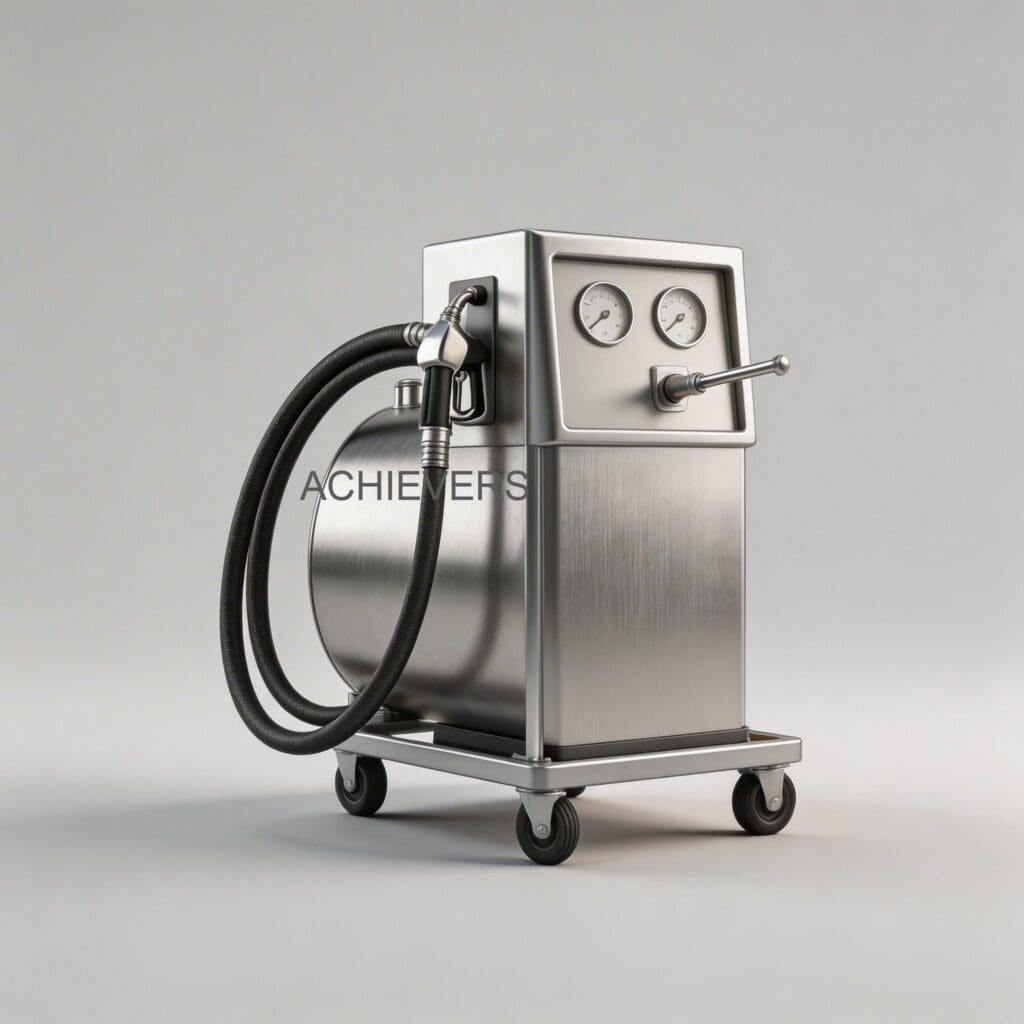
When properly maintained, a high-quality Mobile Fuel Dispenser engineered by Achievers Pumps and Valves is designed to last for years. The key is catching wear before it compromises functionality or accuracy.
2. Preventive Maintenance Schedule
Standardizing maintenance across multiple mobile units ensures no steps are missed. Assign this checklist to your site mechanical team or the designated bowser operator.
| Task | Frequency | Responsible | Est. Time | Notes |
| — | — | — | — | — |
| Visual Walkaround & Leak Check | Daily | Bowser Operator | 5 mins | Inspect pump flange, meter casing, and hose joints for diesel weeping before starting shifts. |
| Nozzle Sensing Port Cleaning | Daily | Bowser Operator | 2 mins | Wipe down the auto shut-off nozzle. Ensure the small vacuum hole at the tip is clear of mud/dust. |
| Cable & Battery Terminal Check | Weekly | Site Technician | 10 mins | For 12V/24V DC units, check for terminal sulfation. For 220V AC, inspect cable insulation for cuts. |
| Inline Strainer/Filter Cleaning | Bi-Weekly | Site Technician | 20 mins | Crucial for protecting the oval gear meter. Clean mesh thoroughly (detailed procedure below). |
| Delivery Hose Inspection | Monthly | Maintenance Head | 10 mins | Check the 4m rubber hose for soft spots, deep abrasions, or cracks at the crimped fittings. |
| Motor Heat Dissipation Check | Monthly | Site Technician | 10 mins | Clean dust and mud caked onto the 0.375 kW motor cooling fins to prevent thermal overload. |
| Mounting & Chassis Hardware | Monthly | Maintenance Head | 15 mins | Tighten all base frame bolts. Vibration from truck mounting can loosen skid plates over time. |
| Volumetric Calibration Check | Quarterly | Quality / Metrology | 45 mins | Dispense into a Legal Metrology certified 20L proving measure to verify ±0.5% accuracy. |
| Meter Seal Inspection | Quarterly | Quality / Metrology | 5 mins | Verify that the Legal Metrology anti-tamper seals on the digital flow meter are intact. |
| Internal Bypass Valve Check | Bi-Annually | Maintenance Head | 30 mins | Ensure the bypass valve opens smoothly when the nozzle is closed while the pump is running. |
3. Step-by-Step Procedures for Key Tasks
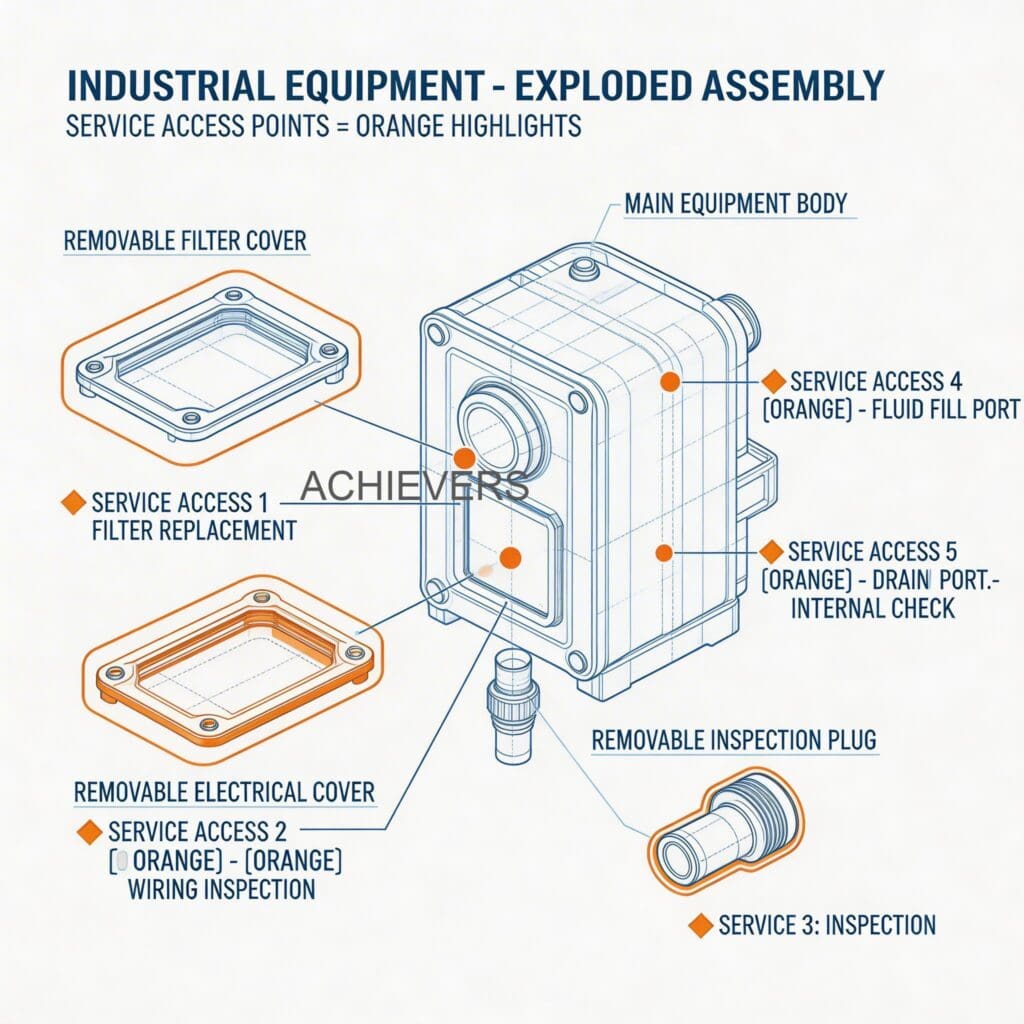
Procedure 1: Cleaning the Inline Strainer (Bi-Weekly)
The strainer is your first line of defense against contaminated diesel. If it clogs, flow rate drops below 60 LPM and the pump cavitates. If it tears, debris enters and destroys the oval-gear meter.
- Isolate Power: Completely disconnect the power supply (unplug the 220V AC or disconnect the 12V/24V DC battery terminals). Lock out the system to prevent accidental starting.
- Close Valves: Shut the isolation valve on the main diesel storage tank or bowser to prevent gravity-fed fuel spills.
- Relieve Pressure: Squeeze the auto shut-off nozzle handle into an empty container to release any trapped 3 Bar line pressure.
- Open Strainer Housing: Place a catch basin under the pump unit. Using the correct size wrench, unbolt the strainer cover located on the inlet side of the transfer pump.
- Remove and Inspect Mesh: Carefully pull out the stainless steel mesh cylinder. Hold it up to the light to inspect for tears, deformities, or collapsed sections. (Replace immediately if damaged).
- Clean the Mesh: Wash the mesh in a clean solvent or clean diesel using a soft nylon brush. Do not use wire brushes or compressed air, as this alters the micron rating of the mesh.
- Check Seals: Inspect the rubber O-ring on the strainer cover. If it is flattened, cracked, or hardened by diesel exposure, replace it to prevent air leaks during suction.
- Reassemble and Prime: Insert the mesh, seat the O-ring, and tighten the cover bolts in a star pattern. Open the storage tank valve, power the unit, and run the pump briefly while squeezing the nozzle to bleed air from the lines.
Procedure 2: Volumetric Accuracy Check (Quarterly)
To ensure your commercial transactions and internal fleet consumption metrics remain legally and financially accurate, you must verify the ±0.5% accuracy of the digital oval-gear meter.
- Procure Certified Measure: Obtain a PESO and Legal Metrology approved 20-liter or 50-liter conical proving measure. Ensure it is clean, dry, and dent-free.
- Level the Equipment: Place the proving measure on a perfectly flat, level surface near the dispenser.
- Wet the Measure: Dispense roughly 5 liters into the measure to wet the internal walls, then empty it completely, allowing it to drip dry for exactly 30 seconds. (This mimics field conditions).
- Reset Display: Clear the resettable batch totalizer on the CE-204 or CE-130 digital display to exactly zero.
- Dispense at Full Flow: Open the nozzle fully and dispense diesel into the measure until the liquid level approaches the 20-liter neck mark, then slowly top it off exactly to the zero-error line on the gauge glass.
- Read Totalizer: Check the digital display on the dispenser. For a 20-liter true dispense, an acceptable reading at ±0.5% accuracy should be between 19.90 and 20.10 liters.
- Perform Repeatability Test: Empty the measure and repeat the test twice more. The readings should not vary by more than ±0.1% between consecutive tests.
- Take Action: If the reading falls outside the ±0.5% window consistently, consult your Achievers service manual to adjust the electronic calibration factor on the digital board, or call for authorized servicing.
4. On-Site Spare Parts to Stock
Procurement heads often wait for a breakdown before ordering parts, causing days of downtime while couriers navigate to remote mining or construction sites. For equipment worth ₹44,000 to ₹100,000+, keeping ₹5,000 worth of strategic spares on-site is a minimal investment for maximum uptime. Consider keeping these parts in stock alongside spares for your other fluid equipment, such as your Diesel Flow Meter.
| Part Description | Type | Recommended Qty | When to Replace / Use |
| — | — | — | — |
| Strainer Mesh Element | Consumable | 2 | When deformed, torn, or severely clogged with sludge. |
| 4m Delivery Hose Assembly | Wear Part | 1 | If outer rubber cracks, inner lining collapses, or leaks occur at crimps. |
| Auto Shut-off Nozzle | Wear Part | 1 | When it fails to shut off automatically, or if dropped/damaged by operators. |
| Pump O-Ring & Seal Kit | Consumable | 2 sets | During annual overhauls or if weeping is noticed around the pump flange. |
| Carbon Vanes (for Rotary Pumps) | Wear Part | 1 set | When flow rate drops significantly below 60 LPM despite a clean filter. |
| Thermal Receipt Paper Rolls | Consumable | 10 | Keep dry in site office for CE-204 models equipped with a printer. |
Common Mistake to Avoid: Bypassing the Strainer
When dealing with heavily contaminated "black market" or poorly stored site diesel, operators often find the inline strainer clogging every few days. A frequent, disastrous mistake is removing the strainer mesh entirely to maintain the 60 LPM flow rate. While this keeps the fuel moving today, it allows grit and rust flakes directly into the high-precision oval gears of the flow meter. Within weeks, the gears will jam or score, destroying the meter’s accuracy and requiring a complete, expensive replacement of the metering block. Always clean the filter; never bypass it.
5. Diagnosing Maintenance-Related Failures
When operators report that a mobile dispenser is "broken," the issue is usually tied to a missed maintenance task rather than a catastrophic hardware failure. Use this diagnostic table to troubleshoot rapidly.
| Failure Symptom | Most Likely Missed Maintenance Task | Corrective Action |
| — | — | — |
| Pump runs, but flow rate is painfully slow (<30 LPM) | Bi-Weekly Strainer Cleaning | Inspect and clean the inline strainer. Check suction hose for internal collapse. |
| Pump runs, but no fuel dispenses at all | Visual Inspection (Air Leaks) | The pump has lost prime. Check O-rings on the strainer housing and ensure the suction line is submerged and sealed. |
| Meter display is blank or flickering | Cable/Terminal Check | Check the 12V/24V battery connections for corrosion, or verify 220V AC power supply voltage. |
| Inaccurate batch totals (short-changing) | Volumetric Calibration Check | Recalibrate the digital meter. If drift is extreme, inspect oval gears for wear from abrasive fuel. |
| Nozzle fails to shut off, causing spills | Nozzle Sensing Port Cleaning | Clean out the small vacuum port inside the nozzle spout. Tap out any dried dirt. |
| Motor feels excessively hot to the touch | Motor Heat Dissipation Check | Clean mud off the motor housing. Ensure operators are not running the pump dry or leaving it in bypass for >3 minutes. |
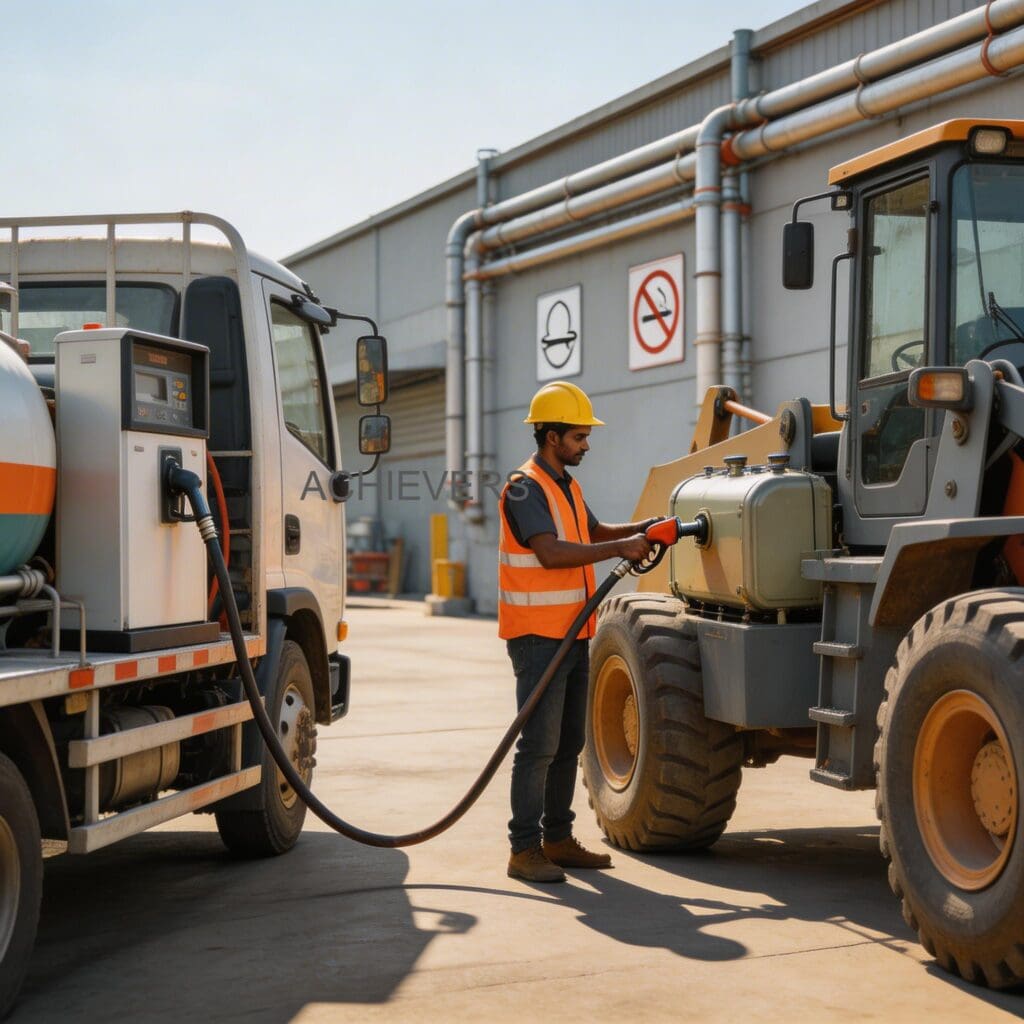
6. Extending Service Life in Indian Conditions
India presents a uniquely challenging operational environment. Adapting your maintenance habits to counter these specific regional conditions will double the lifespan of your unit.
Combating Extreme Heat and Dust (Rajasthan, Gujarat, Central India)
At 45°C ambient temperatures, the 0.375 kW AC motor struggles to dissipate heat. Combined with mining dust, the cooling fins act as an insulating blanket. Mandate a daily wipe-down of the motor casing. Ensure the nozzle is stored properly in its boot—if dropped in the dirt, the auto-shutoff mechanism will ingest dust and jam.
Managing Poor Power Quality
In remote industrial sites and agricultural zones, 220V AC supply can fluctuate violently between 180V and 260V. Low voltage causes the motor to draw higher current, rapidly burning out the windings. For AC units, ensure the dispenser is connected through a high-quality MCB and voltage stabilizer. For 12V/24V DC units mounted on trucks, check the vehicle's alternator health; weak batteries lead to sluggish pump speeds and reduced flow.
Monsoon Humidity and Water Contamination
During the Indian monsoon, the primary threat isn't rain hitting the unit—it's water condensing inside your main storage tanks. Water is heavier than diesel and settles at the bottom, directly where the pump's suction line usually sits. If the pump draws pure water, it lacks the lubricity of diesel, causing internal friction. Periodically drain water from your bulk storage tanks. For the heavy-duty CE-130 steel chassis, touch up any chipped powder coating immediately to prevent aggressive rust.
Handling Highly Contaminated Site Fuel
It is an unfortunate reality that fuel transferred through multiple intermediate tankers before reaching an Indian construction site often picks up rust, scale, and adulterants. In these environments, you must strictly enforce the bi-weekly strainer cleaning schedule. If contamination is severe, consider adding a secondary, high-capacity water-absorbing spin-on filter between the pump and the delivery hose.
FAQ
Q: Our CE-204 is approved by Legal Metrology. Can our mechanics open the flow meter for cleaning?
A: No. Opening the primary metering chamber or tampering with the calibration electronics will break the Legal Metrology Government seals. This renders the unit illegal for commercial transaction use. Only certified technicians should break these seals, and the unit must be re-stamped by a Metrology inspector afterward.
Q: How often does the unit actually need to be recalibrated?
A: For internal fleet use, a quarterly verification check against a proving measure is sufficient, with recalibration only done if readings drift beyond ±0.5%. If you are selling fuel commercially, follow the strict annual or bi-annual re-stamping schedule mandated by your local state Legal Metrology department.
Q: We are using a 12V DC mobile dispenser. Why does it drain the truck battery so quickly?
A: A 12V DC fuel transfer pump draws significant amperage under full load (3 Bar pressure). You should only run the dispenser while the vehicle's engine is idling so the alternator can continually charge the battery. Running it on a dead engine will rapidly deplete the battery.
Q: The receipt printer on our CE-204 keeps jamming during the monsoon. How do we fix this?
A: Thermal printer paper absorbs ambient humidity, causing it to swell and jam the feed rollers. Store spare paper rolls in airtight, dry containers with silica gel packets, and only load a new roll into the dispenser when necessary during heavy rains.
Q: The auto-shutoff nozzle clicks off continuously even when the tank is empty. Why?
A: This usually means the flow rate is too high for the neck of the receiving tank, causing fuel to splash back and prematurely trigger the venturi sensor. It can also mean the internal sensing tube of the nozzle is blocked by debris. Clean the nozzle spout thoroughly.
Q: We want to replace the standard 4-meter hose with a 15-meter hose for better reach. Is this okay?
A: Extending the hose significantly increases friction loss and back-pressure on the transfer pump. It will drop your dispensing speed well below the rated 60 LPM and strain the 0.375 kW motor. If you require longer reach, contact Achievers Pumps to upgrade to the high-capacity CE-130 model paired with an appropriate hose reel system.
Q: Can we use this diesel dispenser to pump petrol or solvents?
A: Absolutely not. Mobile Fuel Dispensers configured for diesel/biodiesel lack the necessary PESO-approved explosion-proof (Flameproof/ATEX) certifications required for highly flammable liquids like petrol. Using it for petrol poses a severe explosion risk and will destroy the pump seals.
If you are experiencing persistent flow rate drops, or if your current refueling equipment is causing bottlenecks at your site, it might be time for an equipment audit. Contact the engineering team at Achievers Pumps and Valves with your specific requirements—flow capacity, fluid type, power availability, and site conditions. Call us at +91-9974192731 or email sales@chintanengineers.in to get a customized, Legal Metrology approved dispensing solution built for India’s toughest environments.