


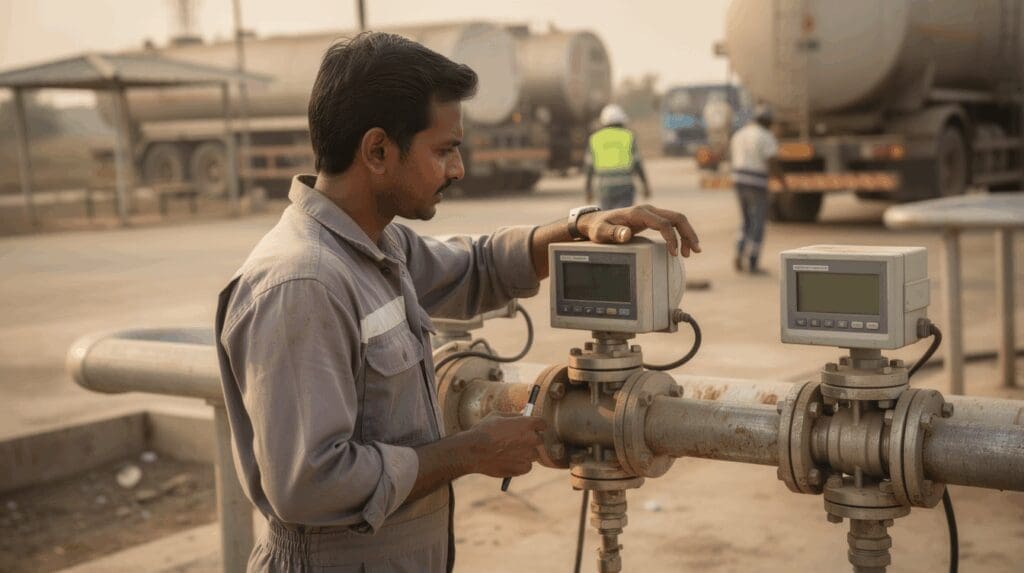
For a 7–40 LPM diesel transfer line, choose the CE-102 digital meter. For higher flows, compare CE-111 variants up to 300 LPM and CE-105 variants up to 1300 LPM, then check the connection, operating limits and readout.
Match the meter to your transfer rate and installation
Buy the digital diesel meter whose stated range covers your lowest and highest operating flow, then check its connection and readout. A meter chosen only for its maximum LPM may miss the slower transfers your team also needs to record.
> Selection diagram: Your lowest and highest flow in LPM → matching model range → connection size → pressure and temperature → display and totals
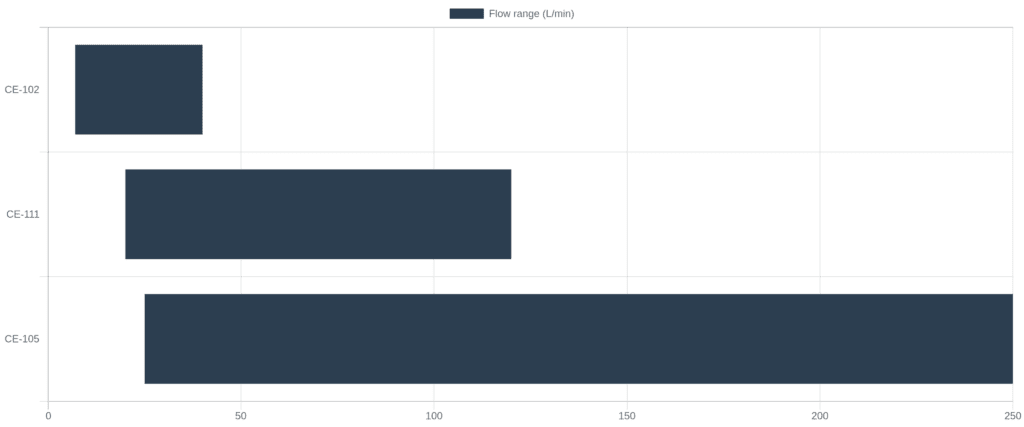
CE-102 covers 7–40 LPM in a compact 3/4-inch nominal size. Three CE-111 digital variants cover ranges from 20–120 to 30–300 LPM. Four variants make up the CE-105 family, with the largest covering 130–1300 LPM.
Compare documented digital meter specifications
The listed digital options span 7–1300 LPM across different variants, so compare each row rather than treating a model family as one size. For CE-102 and CE-105, the size column gives the listed nominal size. CE-111 lists an inlet/outlet size.
| Model or variant | Listed flow range | Listed size or connection | Listed accuracy |
|---|---|---|---|
| CE-102 | 7–40 LPM | 3/4-inch nominal size | ±0.5% |
| CE-111-25 | 20–120 LPM | 25 mm / 1-inch inlet/outlet | +0.5% |
| CE-111-40 | 25–250 LPM | 40 mm / 1.5-inch inlet/outlet | +0.5% |
| CE-111-50 | 30–300 LPM | 50 mm / 2-inch inlet/outlet | +0.5% |
| CE-PDDFM-40 | 25–250 LPM | 40 mm / 1½-inch nominal size | 0.2% |
| CE-PDDFM-50 | 38–380 LPM | 50 mm / 2-inch nominal size | 0.2% |
| CE-PDDFM-80 | 75–750 LPM | 80 mm / 3-inch nominal size | 0.2% |
| CE-PDDFM-100 | 130–1300 LPM | 100 mm / 4-inch nominal size | 0.2% |
The CE-PDDFM variants belong to the CE-105 family. Before you plan pipework, confirm the connection type and mating dimensions for the chosen CE-102 or CE-105 size. If you are also considering a wheel-readout meter, compare mechanical and digital fuel flow meters.
Check accuracy and operating limits before choosing
Use each variant’s stated accuracy to narrow your shortlist, but check its pressure and temperature limits before you buy. CE-102 lists ±0.5%, CE-111 variants list +0.5%, and CE-105 lists 0.2%. These are the stated figures; do not assume they share the same test basis.
CE-102 lists a maximum pressure of 7 bar and a maximum temperature of 70°C. CE-111-25 lists a maximum working pressure of 3.4 MPa; CE-111-40 and CE-111-50 each list 1.8 MPa. All three CE-111 variants list a maximum viscosity of 1000 CPS.
CE-105 lists a maximum pressure of 10 bar and a maximum temperature of 80°C. Check your line’s working conditions against the specific variant you plan to install.
> Common Mistake to Avoid: Do not substitute CE-111-25’s 3.4 MPa pressure limit for CE-111-40 or CE-111-50. Their listed limit is 1.8 MPa.
Choose the readout and totalizer you need
CE-102 gives you a 5-digit LCD display, a 5-digit resettable subtotal with a floating point from 0.001 to 999.99, and an 8-digit non-resettable totalizer. It also carries a pulse output through a built-in reed switch on a single channel, which lets you tie the reading into a separate logging panel if your site needs one. That combination lets your team read a single transfer without disturbing the cumulative record used for stock checks.
CE-111 provides a flow-rate indicator, a flow totalizer, a resettable total and a cumulative totalizer, so operators can zero the transfer count between fills while the cumulative figure keeps running. CE-105 lists a Veeder-Root register that shows both litres and gallons, built for the accuracy work its 0.2% figure is meant for.
If your team relies on totals for stock reconciliation, decide in advance which readings must reset between transfers and which must stay cumulative for audit purposes. That decision, more than the model name, is what determines whether CE-102’s fixed 8-digit totalizer or CE-111’s resettable cumulative counter fits your paperwork.
Use this selection procedure
Shortlist a meter by recording your flow range first, then checking each candidate’s connection, limits and readout. Use this checklist before asking for a quote:
- Record your lowest and highest transfer rates in LPM. Include slower operating periods, not just the pump’s peak rate.
- Keep variants whose full stated range covers both rates. Do not rely on a family’s largest figure.
- Check the pipe connection. Match the stated inlet/outlet size where supplied, and confirm connection details before installation.
- Compare accuracy and operating limits. Use the pressure and temperature of your own line, not another site’s settings.
- Specify the readings your team needs. List flow rate, resettable transfer total, cumulative total and pulse output as separate requirements.
For example, a 120 LPM transfer falls within both CE-111-40’s 25–250 LPM range and CE-PDDFM-40’s 25–250 LPM range. Both list a 40 mm size, but their stated accuracy figures differ: +0.5% and 0.2%. This is a range-based shortlist, not confirmation that either fits your pressure, connection details or required readout.
Keep the selected meter’s readings useful after installation by following a diesel flow meter maintenance checklist.
Frequently asked questions
Which digital diesel meter suits a 7–40 LPM transfer?
CE-102 lists 7–40 LPM and ±0.5% accuracy. Check its 3/4-inch nominal size and its 7 bar and 70°C maximum limits against your line.
Which listed digital meter variant covers the highest flow rate?
CE-PDDFM-100, in the CE-105 family, lists the highest upper limit: 1300 LPM. Its full stated range is 130–1300 LPM, so check your minimum flow too.
Do the listed digital meters all have the same accuracy?
No. CE-102 lists ±0.5%, CE-111 variants list +0.5%, and CE-105 lists 0.2%. Compare the figure for the exact variant on your shortlist.
Which digital diesel flow meter should I buy?
Start with CE-102 for 7–40 LPM. For higher flows, match your full operating range to a CE-111 or CE-105 variant, then verify its connection, limits and readout.
- CE-102: Your transfer runs within 7–40 LPM and you need an LCD plus pulse output.
- CE-111-40: Your flow stays within 25–250 LPM and you need a flow-rate indicator and totals.
- CE-PDDFM-40: Your flow stays within 25–250 LPM and you are comparing the CE-105 family’s 0.2% accuracy figure.
- CE-PDDFM-100: Your flow stays within 130–1300 LPM; confirm the 100 mm connection details.
