For industrial operations, continuous power generation is non-negotiable. Whether you are running offshore platforms, remote mining sites, or critical manufacturing facilities, diesel generators form the backbone of your power security. However, diesel fuel is often one of the largest unoptimized OPEX line items on the balance sheet. Shrinkage through theft, unrecorded equipment inefficiencies, and inaccurate manual logbooks can account for a 5% to 15% discrepancy in fuel budgets annually. Operations managers and procurement heads can no longer rely on dipsticks or basic tank level sensors to govern millions of dollars in fluid assets.
To bridge this operational gap and secure your fluid handling investments, deploying a Fuel Consumption Meter offers immediate accountability. By capturing the exact differential between the fuel supplied to the engine and the unburnt fuel returning to the tank, you gain total visibility into actual engine efficiency. This consultative breakdown quantifies the total cost of ownership (TCO) for a Fuel Consumption Meter, providing a comprehensive return on investment (ROI) framework, a procurement checklist, and technical strategies to eliminate fuel theft and optimize generator runtime.
Quick ROI Snapshot
- Typical capital outlay: Recovered well within the current budget year.
- Average fuel savings: 5% to 12% reduction in unaccounted fuel losses.
- Typical payback period: 3 to 8 months (depending on engine horsepower and run hours).
- System accuracy: 0.5% of genuine fuel consumption.
1. Product Overview and Cost Context
Measuring fuel consumption on modern industrial diesel engines is not as simple as installing a single flow meter on the supply line. Diesel engines use a common rail or unit injector system that draws significantly more fuel than the engine actually burns. The excess fuel—which is heated and highly aerated by the engine—is returned to the diesel tank. If you only measure the inlet line, your fuel consumption data will be drastically overstated, rendering the data useless for theft prevention or efficiency tracking.
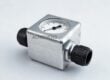
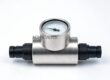
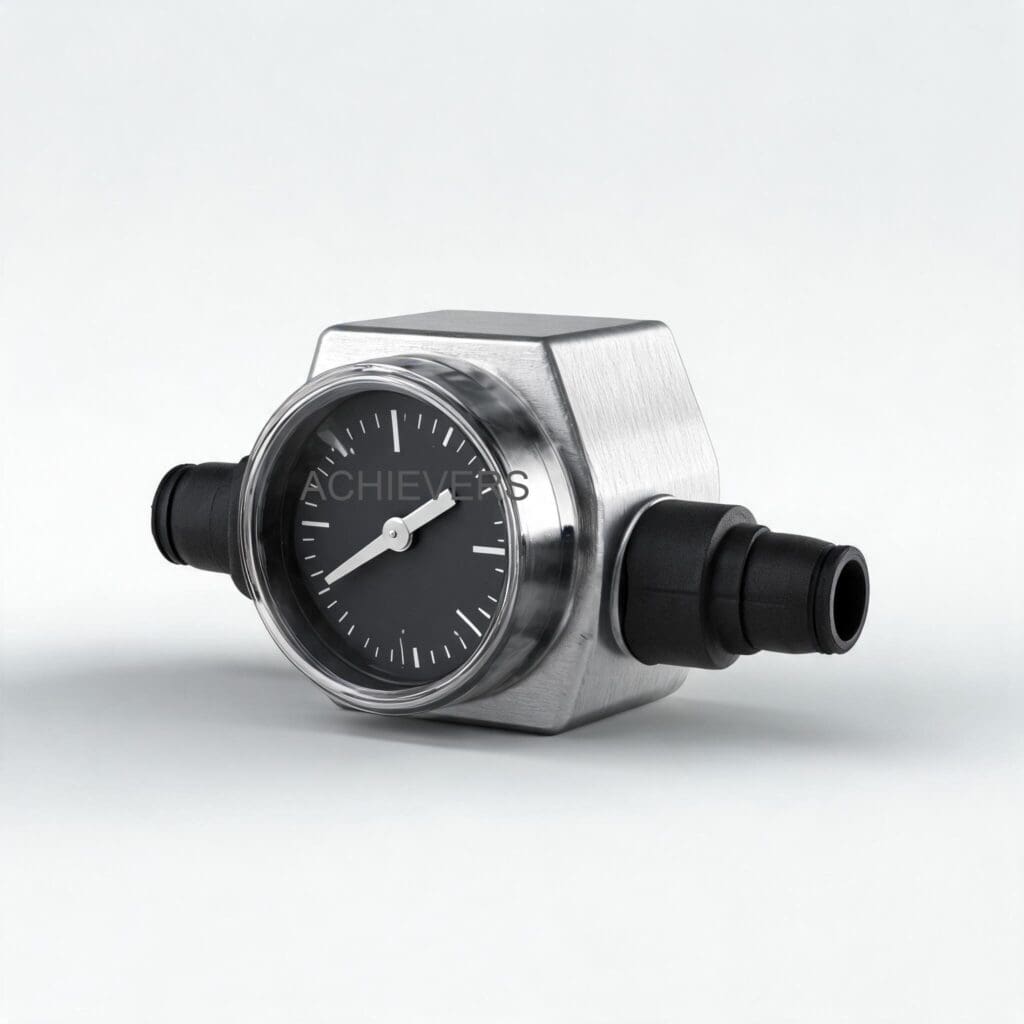
A genuine Fuel Consumption Meter solves this through a highly precise differential measurement architecture. It integrates two separate, highly accurate oval gear flow sensors: one tracking the inlet line (diesel flowing to the motor) and a second tracking the return yield (diesel flowing back to the tank).
Crucially, because the return fuel is full of air bubbles from the injection process, the return flow must be deaerated before passing through the second sensor. Once measured, a dedicated microcontroller—the fuel calculator—processes the data from both sensors. It continuously subtracts the return volume from the inlet volume to deliver true consumption data. Because oval gear sensors operate on a positive displacement principle, they are highly immune to variations in fuel viscosity caused by extreme global temperature fluctuations.
Model Selection by Engine Size
Selecting the right system size is critical to avoid pressure drops in your fuel lines. Achievers provides distinct models based on engine horsepower (HP):
| Model Series | Flow Sensor Type | Engine Capacity Range | Typical Application |
| — | — | — | — |
| FCM:006 | CE-006 (2 units) | Up to 200 HP | Telecom towers, small commercial backup |
| FCM:008 | CE-008 (2 units) | 200 HP to 400 HP | Mid-size manufacturing, construction sites |
| FCM:012 | CE-012 (2 units) | 400 HP to 1000 HP | Heavy manufacturing, mining camps |
| FCM:020 | CE-020 (2 units) | 1000 HP to 1500 HP | Large-scale power plants, grid backup |
| FCM:025 | CE-025 (2 units) | 1500 HP to 2500 HP | Offshore rigs, maritime propulsion |
2. Total Cost of Ownership Breakdown
When evaluating fluid measurement systems, plant engineers often focus solely on the capital expenditure (CAPEX) of the flow sensors. However, accurate TCO analysis must account for installation, integration, power supply infrastructure, and long-term maintenance over the lifecycle of the unit. Below is a realistic breakdown of the TCO elements for a differential generator metering system.
| Cost Component | Typical TCO Impact | Frequency | Technical Notes |
| — | — | — | — |
| Initial Equipment Purchase | 30% – 40% | Once | Includes Y-strainer, inlet/return oval gear sensors, and digital calculator display. |
| Installation Labour & Piping | 10% – 15% | Once | Requires cutting into existing fuel lines, installing bypass loops, and mounting the deaerator. |
| Telemetry Integration | 5% – 10% | Once | Connecting the RS-485 / RS-232 / Pulse output to site GPS or SCADA (GPRS modem). |
| Power Infrastructure | < 5% | Once | Unit requires 5 Vdc to 24 Vdc, easily tapped directly from the 12/24V engine starter battery. |
| Filtration Consumables | 5% – 8% | Annual | Replacing/cleaning Y-type strainer baskets to protect the precision oval gears. |
| Preventative Maintenance | 10% – 15% | Annual | Routine inspection of wiring, seal integrity, and flow sensor verification. |
| Periodic Calibration | 10% | Every 1-2 years | Validating sensor accuracy (0.1% FSD standard) against master provers. |
| Planned Downtime | 5% – 10% | Annual | Minimal. With bypass piping installed during commissioning, DG uptime is unaffected. |
Common Mistake to Avoid
Skipping upstream filtration. Oval gear meters offer incredible accuracy (0.1% full-scale deflection), but they rely on tight internal clearances. Bypassing or removing the recommended Y-type strainer will allow rust, sludge, or particulate matter from aging diesel tanks to lock the gears, leading to fuel starvation at the engine and costly sensor replacements.
3. ROI Calculation: Real-World Global Example
To justify the procurement of a sophisticated metering system, operational heads must present a clear financial payback model. The following 8-step calculation illustrates how to model ROI for a heavy-duty continuous generator.
The Scenario:
A remote mining operation runs a 1000 HP generator continuously for 12 hours a day. The engine consumes roughly 150 liters of diesel per hour. Plant management suspects a 6% loss due to a combination of unauthorized siphoning and degraded engine efficiency that manual tank dipping cannot detect.
- Establish Daily Consumption:
- Calculate Annual Consumption:
- Quantify the Unaccounted Loss:
- Monetize the Annual Loss:
- Estimate Total TCO (CAPEX + Install):
- Calculate the Recovered Capital:
- Calculate Net Year-One Savings:
- Determine Simple Payback Period:
150 liters/hour x 12 hours/day = 1,800 liters consumed daily.
1,800 liters/day x 300 operational days = 540,000 liters per year.
At a 6% estimated loss rate, the facility is losing: 540,000 x 0.06 = 32,400 liters annually.
Assuming a global average diesel cost of $1.10 per liter:
32,400 liters x $1.10 = $35,640 in annual financial leakage.
Procuring an FCM:012 system, modifying piping, adding telemetry, and labor totals an estimated $3,500.
With an accuracy of 0.5% of genuine consumption, the differential system immediately flags the 6% discrepancy. Through theft deterrence and immediate maintenance triggers, the facility recovers $35,640 per year.
$35,640 (Savings) – $3,500 (TCO) = $32,140 added directly back to the bottom line.
$3,500 (Investment) / $35,640 (Annual Savings) = 0.098 years.
0.098 x 12 months = 1.17 months.
In heavy-use scenarios, the payback period is exceptionally short. Even for smaller generators used only for backup power, ROI is typically achieved within 6 to 12 months.
4. Cost Comparison: Available Approaches
Plant engineers often face pushback from procurement teams who want to stick with cheaper, outdated monitoring methods. Here is how differential consumption measurement compares against legacy approaches.
| Monitoring Approach | Upfront Cost | Annual Maintenance Cost | System Accuracy | Reliability for Theft Control | Best Suited For |
| — | — | — | — | — | — |
| Manual Dipstick / Logbooks | Zero | High (Labor intensive) | Low (± 10-15%) | Extremely Poor | Very small, non-critical residential backup tanks. |
| Tank Level Sensors (Hydrostatic/Ultrasonic) | Low to Medium | Low | Moderate (± 2-5%) | Poor (Cannot detect fuel tapped directly from engine lines) | Static inventory tracking in bulk storage tanks. |
| Single Diesel Flow Meter (Inlet only) | Medium | Medium | Inaccurate for engine consumption | Poor (Cannot account for return fuel loops) | Simple transfer pumps or Fuel Flow Meter dispensing points. |
| Differential Fuel Consumption Meter | Moderate to High | Low to Medium | Excellent (0.5% true consumption) | Highly Secure (Flags any engine-line tampering) | High-HP generators, mobile fleets, heavy construction equipment. |
5. Hidden Costs to Budget For
When integrating precision instrumentation into rugged environments, foresight prevents budget overruns. Factor these 6 hidden costs into your procurement planning:
- Deaeration Space and Orientation: Return fuel must be deaerated before passing through the return oval gear sensor. Budget for the space required to mount the deaerator vertically; improper installation angles can compromise the 0.5% accuracy rating, requiring costly rework.
- Piping Modifications for Bypass Lines: Do not install flow sensors directly inline without a bypass valve loop. Without a bypass, maintaining or cleaning the Y-strainer requires shutting down the generator. The extra piping and 3-way valves add a minor upfront cost but prevent catastrophic downtime.
- Telemetry and Data Subscription Fees: The digital display provides localized RS-485 or pulse outputs. If you want this data pushed to a cloud dashboard for remote viewing, you must budget for a GPRS modem, a GPS gateway, and the associated recurring cellular data SIM costs.
- Power Conditioning in Harsh Environments: The micro-controller is designed to accept 5 Vdc to 24 Vdc (operating up to 29 Vdc safely off the engine battery). However, if your starting motors create massive voltage spikes, an inexpensive inline voltage stabilizer will protect the sensitive electronics from frying.
- Quality of the Y-Strainer: Budget for high-quality, fine-mesh Y-strainers and spare filter baskets. Poor quality diesel heavily loaded with asphaltines or rust will clog strainers quickly. Having spares on hand reduces labor time during PMs.
- Annual Calibration Verification: To maintain ISO compliance and internal audit standards, the flow sensors should be periodically verified. Factor in the cost of hiring a third-party calibration technician or using a master prover every 12 to 24 months.
6. How to Justify the Purchase to Management
Bridging the gap between the engineering floor and the executive suite requires translating technical benefits into risk reduction and financial gains. Use this 6-step procedure to build an unassailable business case:
- Establish a Baseline Audit: Gather the past 12 months of diesel purchase orders and compare them against the logged generator runtime hours and the manufacturer's stated fuel burn rate. Calculate the variance.
- Quantify the Financial Risk: Convert that variance volume into hard currency. Present this number not as an "efficiency opportunity," but as direct financial shrinkage affecting operating margins.
- Draft the Technical Superiority Argument: Explain briefly why single-meter or tank-level approaches fail for diesel engines (highlighting the common-rail return line). Show that a differential system is the only scientifically valid way to measure true burn rates.
- Present the Integration Capabilities: Highlight the RS-485 / RS-232 integration. Show how the digital output will tie directly into the company’s existing SCADA or GPS fleet tracking system, removing human error from logbooks.
- Model the Payback Period: Use the 8-step ROI calculation provided in Section 3, customized to your facility's specific fuel consumption numbers. Show management the exact month the system pays for itself.
- Propose a Pilot Installation: If capital is tight, propose installing an FCM:008 or FCM:012 on a single high-use generator as a proof of concept. Use the localized LCD display (showing total fuel to motor, total fuel returned, and total time) to prove the data accuracy before a plant-wide rollout.
FAQ
Q: What is the overall accuracy of the system?
A: The total system accuracy is 0.5% of genuine consumption. This is achieved because each individual aluminum oval gear flow sensor is precision-machined to an accuracy of 0.1% Full Scale Deflection (FSD).
Q: Can this handle extreme engine sizes and flows?
A: Yes. The system is scalable. While the CE-006 model handles up to 200 HP engines, the CE-025 model can comfortably monitor large 1500 HP to 2500 HP power generation engines.
Q: Why do I need two sensors instead of just monitoring the main fuel tank?
A: Tank level sensors cannot track efficiency variations in real-time, nor can they detect if fuel is being siphoned directly from the generator’s supply lines. Differential measurement explicitly isolates the engine's exact consumption.
Q: Does the return fuel cause air-lock in the second sensor?
A: No. Diesel engine return lines contain highly aerated fuel. The system is specifically engineered with a deaerator prior to the return flow sensor to eliminate air pockets, ensuring only liquid volume is calculated.
Q: How is the system powered in remote locations?
A: The system requires minimal power (5 Vdc to 24 Vdc). It is designed to be wired directly into the generator's onboard 12V or 24V starter battery, requiring no external main grid power.
Q: Can the meter connect to our central plant monitoring software?
A: Absolutely. The fuel calculator comes equipped with optional RS-485, RS-232, and pulse outputs, making it ready to interface with modern GPRS modems, GPS tracking systems, and SCADA architectures.
Q: What units does the digital calculator display?
A: The onboard microcontroller can be factory-calibrated to display volumetric data in Liters, Gallons, or Cubic Meters, depending on your regional operational standards.
Achievers Pumps and Valves is dedicated to engineering fluid handling solutions that deliver transparent data and rapid ROI. If you are ready to eliminate fuel shrinkage and take control of your generator operations, contact our technical team today. Please provide your engine horsepower, expected flow rates, and site conditions, and we will specify the exact Fuel Consumption Meter configuration required to secure your fluid assets.