Industrial fluid transfer operations in India are uniquely demanding. Between freezing winter mornings in North India and scorching peak summer temperatures across the plains, industrial oils undergo dramatic shifts in viscosity. If your plant processes Furnace Oil (FO), Light Diesel Oil (LDO), hydraulic fluids, or vegetable cooking oils, your measurement accuracy is entirely at the mercy of fluid dynamics and temperature fluctuations.
For plant managers and procurement heads, selecting the right metering technology is a high-stakes decision. Make the wrong choice, and you will face continuous calibration drift, inventory shrinkage, and disputes during custody transfer. The confusion typically boils down to two dominant technologies: Positive Displacement (specifically oval gear) and Turbine flow meters.
This guide will dissect both technologies, linking meter mechanics to real-world outcomes like accuracy stability, maintenance burdens, and downtime risks. By the end, you will know exactly how to specify Oil Flow Meters that eliminate mis-metering losses and deliver unshakeable accuracy regardless of site conditions.
Quick ROI Snapshot
- Typical payback period: 6 to 12 months for a high-quality positive displacement meter.
- Primary savings driver: Eliminating the 1% to 3% volumetric slippage typically experienced when using incorrect turbine meters for fluctuating viscosity oils.
- Downtime reduction: Integrated strainers and low-maintenance oval gear designs reduce unplanned calibration shutdowns by up to 80%.
Common Mistake to Avoid
Do not install a standard turbine flow meter for high-viscosity fluids like Furnace Oil (FO) simply because the initial capital expenditure is lower. Turbine meters rely on fluid velocity; as oil thickens, it drags on the rotor blades, drastically skewing the calibration curve. The money saved on procurement will be lost within the first month due to inaccurate batching and unrecorded fluid transfers.
1. Overview of Oil Flow Meters Family
Before comparing performance, it is critical to understand the mechanical principles governing these two distinct types of Oil Flow Meters. While both measure fluid moving through a pipe, they do so using completely different fundamental physics.
Positive Displacement (Oval Gear) Flow Meters
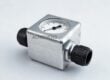
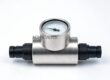
Positive Displacement (PD) meters, specifically the oval gear design, are precision fluid measuring instruments that act like a continuous, automated measuring cup. Instead of guessing volume based on speed, they divide the fluid into exact, physical volumetric increments. The fluid pressure forces two machined oval gears to rotate in a synchronized motion. Each revolution passes a precise, unvarying volume of liquid.
Because the internal moving parts are dynamically locked in tandem with the volume of fluid, these Oil Flow Meters maintain their step-less calibration across massive viscosity shifts. They are entirely unaffected by outside flow disturbances caused by piping geometry, meaning they require no straight pipe runs before or after the meter. Furthermore, they instantly move when there is smooth fluid motion and immediately stop when the motion stops, making them flawless for intermittent flows and precise dispensing in petroleum terminals and process control industries.
Turbine Flow Meters
Turbine meters are velocity-based devices. They feature a multi-bladed rotor suspended in the flow stream. As fluid passes through the meter body, it impacts the rotor blades, causing them to spin at a speed proportional to the fluid's velocity. A magnetic pickup sensor detects the passing blades and generates a frequency output that is converted into a flow rate and total volume.
While highly effective for clean, low-viscosity, and stable fluids (like water or highly refined petrochemical solvents), turbine meters are highly sensitive to viscosity changes. As oil gets thicker, the fluid velocity profile changes from turbulent to laminar, creating drag on the rotor and causing significant measurement errors at lower flow rates.
2. Head-to-Head Specification Comparison
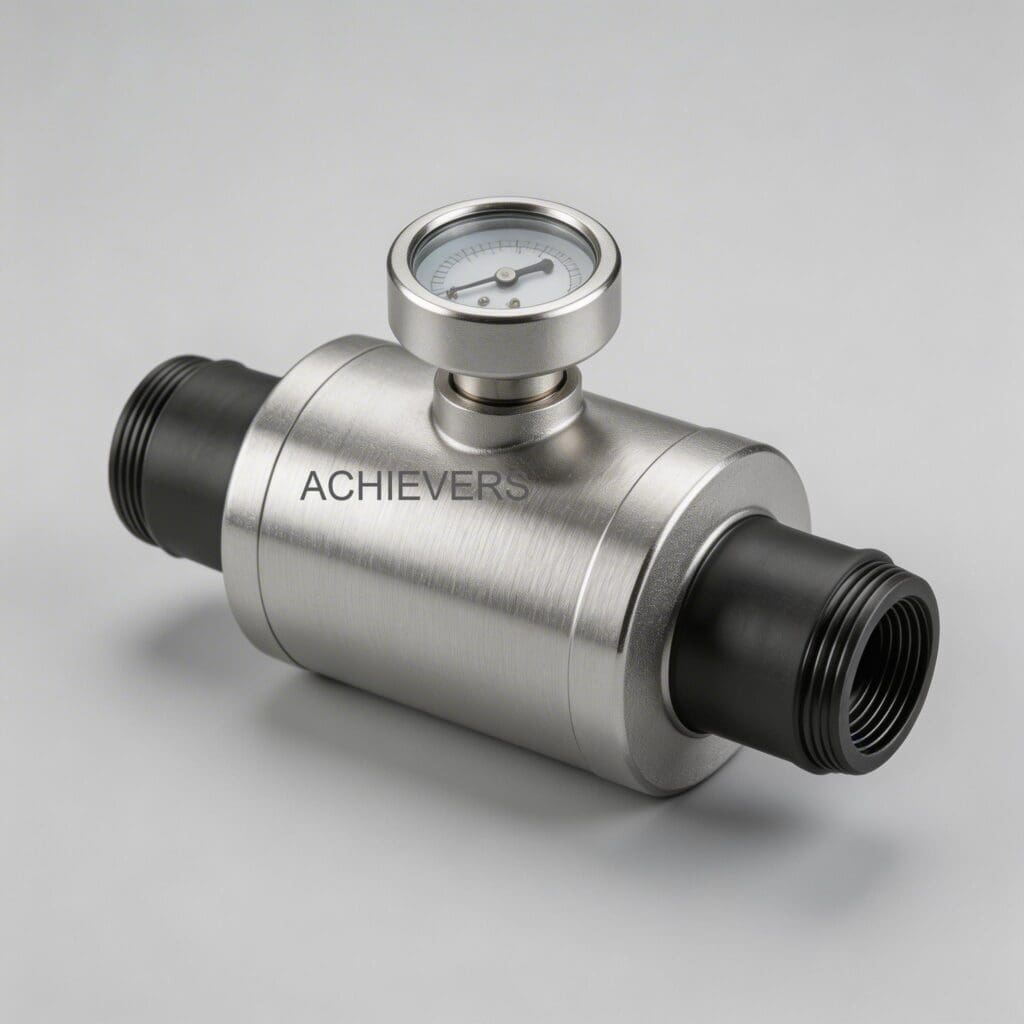
When evaluating digital oil flow meters, flange type oil flow meters, or specific instruments like a hydraulic oil flow meter, the technical specifications dictate site compatibility. The table below directly compares the precision-engineered Achievers oval gear meter against typical industrial turbine meters.
| Feature / Specification | Positive Displacement (Achievers Oval Gear) | Standard Industrial Turbine Meter |
| — | — | — |
| Measurement Principle | Volumetric displacement (physical trapping of fluid) | Velocity-based (rotor spinning in fluid stream) |
| Line Size Availability | 006mm to 150mm (1/4 inch to 6 inch) | Typically 15mm to 300mm (1/2 inch to 12 inch) |
| Viscosity Tolerance | Exceptional; accuracy actually improves with higher viscosity as clearances seal perfectly. | Poor; requires strict calibration curves (K-factors) for specific fluid viscosities. |
| Repeatability | Superior to 0.02% | 0.1% to 0.5% (highly dependent on stable viscosity) |
| Piping Requirements | None. Not affected by outside components or installation geometry. | Requires 10x pipe diameters upstream and 5x downstream of straight pipe. |
| Flow Turndown Ratio | High (captures low flow rates accurately without slippage) | Lower (loses accuracy rapidly at low flow velocities) |
| Pressure Drop | Low pressure drop; excellent for both gravity and pump (in-line) applications. | Moderate to High at peak flows; not ideal for low-head gravity feeds. |
| Filtration Needs | Provided with an integrated mesh strainer to protect tight gear tolerances. | Requires standalone upstream Y-strainers to prevent rotor damage. |
| Display Flexibility | Register head can be easily removed and rotated every 90º for reading orientation. | Usually fixed or requires complex bracket modifications to change viewing angle. |
| Calibration Units | Step-less calibration system available in Liter, US Gal, UK Gal. | Multi-point electronic linearization required for different units/fluids. |
3. Application Comparison Table
Different industrial operations require different technological approaches. Selecting a vegetable cooking oil flow meter for food processing is entirely different from selecting a mineral oil flow meter for heavy mining equipment. Here is how PD and Turbine meters stack up across common Indian industrial applications.
| Application Scenario | Recommended Option | Technical Reason & Justification |
| — | — | — |
| Furnace Oil (FO) Unloading | Positive Displacement (Oval Gear) | FO is highly viscous. Oval gears trap the thick fluid perfectly, eliminating measurement slippage at varying unloading pump speeds. |
| Aviation Refueling Vehicles | Positive Displacement (Oval Gear) | Requires extreme repeatability (better than 0.02%) and reliability under intermittent flow conditions at distribution depots. |
| High-Speed Clean Water Batching | Turbine Meter | Low viscosity fluid at consistent high velocities is the optimal operating environment for a velocity-based rotor. |
| Gravity-Fed Lubrication Lines | Positive Displacement (Oval Gear) | The low pressure drop design handles gravity-fed, low-flow operations accurately without requiring high pump pressure to spin a rotor. |
| Fluctuating Temp Vegetable Oil | Positive Displacement (Oval Gear) | Vegetable oil viscosity changes drastically from morning to afternoon. PD meters maintain accuracy predictable between calibration levels regardless of these shifts. |
| Tight Spaces / Skid Integration | Positive Displacement (Oval Gear) | Zero straight pipe requirements mean the meter can be bolted directly next to elbows, valves, and pumps on compact mobile skids. |
| Dirty / Contaminated Fluid Transfer | Neither (Needs Heavy Filtration) | However, Achievers PD meters come with an integrated mesh strainer to catch particulates, making them safer if minor contamination is present. |
| Continuous Engine Fuel Monitoring | Positive Displacement (Oval Gear) | Diesel engines have pulsating, low-volume fuel flows with return lines. PD meters accurately capture the exact fractional volume consumed. |
4. Total Cost Comparison
Procurement teams must look beyond the initial purchase order. The Total Cost of Ownership (TCO) in India includes maintenance labor, downtime costs, calibration expenses, and the financial impact of measurement inaccuracy.
| Option | Purchase Range (INR) | Annual Maintenance & Calibration | Expected Life | Best Financial Fit For |
| — | — | — | — | — |
| Achievers Oval Gear PD Meter (Standard) | ₹35,000 – ₹1,20,000 | Low. Strainer cleaning and occasional gear inspection. Step-less mechanical calibration is highly stable. | 10 to 15+ years | Petroleum distribution, batching, custody transfer, high-viscosity oils. |
| Large Bore Oval Gear (up to 150mm/6") | ₹1,50,000 – ₹5,50,000 | Moderate. Requires handling gear for large flange sizes, but internally robust. | 15+ years | High-volume terminal loading, ship bunkering, large-scale process control. |
| Standard Industrial Turbine Meter | ₹20,000 – ₹85,000 | High. Frequent K-factor recalibration needed if fluid temperature/viscosity changes. Rotor bearing replacements. | 5 to 8 years | Utilities, water processing, stable light-solvent measuring where accuracy is secondary. |
| High-Precision Coriolis Meter | ₹4,00,000 – ₹15,00,000 | Low maintenance, but extremely expensive initial calibration and complex electronics. | 10+ years | Advanced chemical processing where mass flow (not just volume) must be measured. |
5. Decision Guide: Which One for Your Plant?
When you are ready to upgrade your plant's fluid handling infrastructure, use this step-by-step decision matrix. It bridges the gap between engineering specifications and actual plant floor realities.
- Assess Your Fluid's Viscosity Profile
- Evaluate Flow Rate Variations
- Check Available Installation Space
- Consider Gravity vs. Pump Flow
- Factor in Display Orientation Needs
- Analyze Fluid Contamination Risks
- Identify Custody Transfer & Legal Metrology Needs
- Evaluate Mobile vs. Stationary Requirements
If your fluid is thicker than water (e.g., LDO, FO, gear oil, hydraulic fluid), a Positive Displacement oval gear meter is your primary choice. Thick fluids enhance the sealing between the oval gears and the measuring chamber, pushing your accuracy and repeatability to peak levels (0.02%). Turbine meters will simply drag and under-report the volume.
Does your process involve instant stops, starts, or variable speed pumping? PD meters instantly capture movement and stop precisely when flow ceases. If you are integrating this into a Liquid Batching System for mixing chemicals or food ingredients, the PD meter guarantees exact volumetric dosing without overrun errors.
Examine the piping where the meter will be installed. If you are retrofitting a meter into an existing manifold and do not have 10 pipe diameters of straight, unencumbered pipe before the meter, you cannot use a turbine meter. PD meters are entirely unaffected by upstream valves or elbows.
Many older Indian plants rely on overhead tanks for gravity-fed fuel distribution. The low pressure drop design of a quality oval gear meter ensures that even low-head gravity flows are measured accurately without starving the downstream equipment of liquid.
In complex petrochemical pipelines, a fixed display might face a wall or require the operator to use a ladder. Opt for meters where the register head can be easily removed and rotated to every 90º orientation. This ensures safe, ergonomic, and error-free manual reading.
Indian site conditions often involve dust, scale from old pipes, or contaminated fuel deliveries. Always choose a meter provided with a coordinated work strainer (integrated mesh strainer). This protects the precision-machined internal components from catastrophic jamming, saving you from complete meter replacement.
If money is changing hands based on the meter reading—such as unloading a diesel bowser at a mining site or dispensing fuel—you need sustained accuracy. The step-less calibration system in Achievers PD meters ensures that accuracy remains predictable between calibration levels, making Legal Metrology Act compliance straightforward.
If the meter is mounted on a vibrating diesel engine or a mobile dispensing truck, turbine rotors can suffer premature bearing wear. The sturdy construction of an oval gear meter handles mobile rigors efficiently. If tracking engine efficiency is the goal, consider pairing your setup with a dedicated Fuel Consumption Meter designed for pulsation resistance.
FAQ
Q: Why does my current turbine meter show less volume than the oil tanker receipt during winter?
A: In colder temperatures, oil viscosity increases significantly. The thicker oil causes viscous drag on the turbine blades, making them spin slower than they should for a given volume. This results in the meter under-reporting the transferred fuel. Upgrading to a positive displacement meter solves this entirely.
Q: Do I need to install a separate filter before an oval gear meter?
A: While it is always good engineering practice to have coarse filtration in your main line, Achievers oval gear meters are provided with a coordinated integrated mesh strainer. This built-in protection ensures that stray particulates do not damage the precision gears, simplifying your installation.
Q: Can I use an oval gear meter for low-pressure gravity unloading from an overhead tank?
A: Absolutely. Achievers meters feature a specifically engineered low pressure drop design that takes into account both gravity and pump (in-line) applications. They will accurately record flow even when the driving head pressure is minimal.
Q: What is the maintenance schedule for a Positive Displacement meter handling furnace oil?
A: Because of its simple design and robust construction, maintenance is minimal. You should periodically check and clean the integrated mesh strainer, especially after new fuel deliveries. Annual calibration checks are recommended, but the step-less calibration system ensures high stability over long periods of operation.
Q: How difficult is it to change the viewing angle of the mechanical display?
A: It is designed for complete serviceability. The register top can be effectively removed and rotated to each 90-degree orientation. This allows operators to easily read the display whether the piping runs vertically, horizontally, or close to a corner wall.
Q: Are these meters compliant with standard Indian piping sizes?
A: Yes. The meters are available in line sizes ranging from 006mm to 150mm (1/4 inch to 6 inch), covering everything from small hydraulic lubrication lines to massive bulk terminal distribution pipes. They are easily flanged or threaded into standard Indian industrial pipework.
Q: What kind of warranty protects my investment in an Achievers meter?
A: Achievers provides a standard 1-year warranty on these high-precision instruments. Additionally, a 2-year extended warranty is available on demand, backed by guaranteed spare parts availability to ensure your operations never suffer long-term downtime.
Ready to eliminate measurement errors and secure your fluid handling operations? Reach out to the technical experts at Achievers Pumps and Valves today. Provide us with your pipe line size, expected flow rate, fluid type, and operating temperature range, and our engineers will custom-configure the perfect positive displacement metering solution to deliver unshakeable accuracy for your plant.