In any Indian manufacturing plant, logistics hub, or heavy construction site, diesel is the lifeblood that keeps operations running. Between backup Diesel Generator (DG) sets, captive fleet vehicles, forklifts, and heavy earth-moving machinery, industrial facilities consume thousands of liters of fuel monthly. Yet, while most operations managers rigorously track raw material inventory down to the gram, captive diesel storage is often managed with outdated dipsticks, manual logbooks, and rudimentary transfer pumps.
This gap in fluid management creates a massive blind spot. When you rely on gravity-fed agricultural meters or uncalibrated bucket transfers, you invite inaccurate internal billing, fuel contamination, and unchecked pilferage. For Indian industrial engineers and plant managers dealing with tight margins, every drop of unaccounted diesel represents a direct hit to the bottom line.
Deploying professional Fuel Dispensers at your factory yard is not just about moving liquid from an underground tank to a generator. It is about creating an auditable, secure, and highly accurate point of transfer that protects your fluid handling investment.
Quick ROI Snapshot
- Typical capital investment: Starting from INR 44,000 + GST
- Average monthly fuel volume handled: 15,000 Liters
- Average pilferage/loss reduction: 2% to 4%
- Typical payback period: 4 to 6 months
- Secondary benefits: Reduced engine wear on DG sets due to inline filtration; elimination of manual measurement labor.
1. Industry Overview: The Fluid Challenge
Managing captive fuel storage in the Indian industrial landscape comes with a unique set of challenges. Site conditions are famously harsh. Equipment must operate in 45°C summer heat, endure the high humidity of the monsoon season, and survive highly dusty environments in cement plants, mines, or construction yards.
Furthermore, diesel delivered by third-party tankers often contains particulate matter, rust, or water ingress. Pumping this contaminated fuel directly into a ₹50,00,000 DG set or an expensive excavator can lead to catastrophic fuel injector failure. Therefore, the dispensing mechanism must not only measure the fluid but also condition it.
Accuracy is another major hurdle. Due to temperature fluctuations throughout the day, the volume of diesel expands and contracts. Simple flow indicators or dipstick measurements fail to account for these nuances, resulting in "shrinkage" at the end of the month when procurement audits the fuel logs. A facility needs a dispensing solution that offers absolute precision, ensuring that the volume drawn from the bulk tank matches the volume consumed by the plant equipment.
2. Product Capabilities Matched to Industry Needs
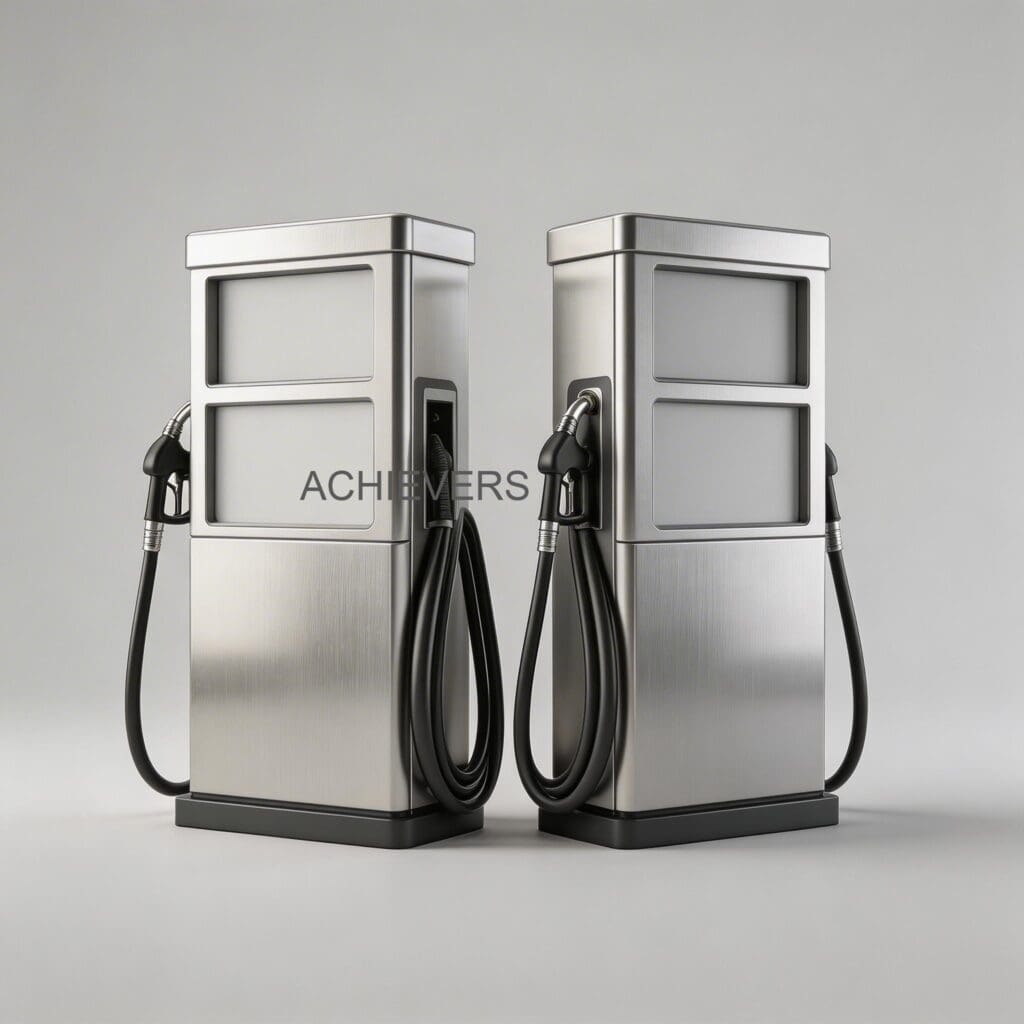
Generic water pumps or cheap imported transfer kits simply cannot survive industrial duty cycles or deliver the accuracy required for factory audits. Achievers Pumps and Valves manufactures equipment specifically engineered for these realities. Below is a breakdown of how our Fuel Dispensers match the rigorous demands of Indian industry.
| Industry Requirement | Dispenser Feature | How It Addresses the Need |
| :— | :— | :— |
| High Audit Accuracy | ±0.5% Accuracy & ±0.1% Repeatability | High-precision piston or oval-gear flow meters ensure every drop is logged correctly, eliminating internal disputes between departments. |
| Bulk Tank Compatibility | Self-Priming Vane or Gear Pump | Effortlessly draws fuel from both underground (UG) and above-ground (AG) storage tanks without manual priming. |
| Engine Protection | Built-in Large-Capacity Filter | Captures rust, dust, and particulate matter before the fuel enters the meter or the machinery, extending DG set and vehicle lifespan. |
| Spillage Prevention | Automatic Shut-off Nozzle | The nozzle automatically clicks off when the recipient tank is full, preventing expensive and hazardous overflows. |
| Harsh Environment Durability | Powder-Coated Steel Enclosure | Built rugged to withstand Indian summers, monsoon rains, and corrosive or dusty industrial environments. |
| Power Grid Fluctuations | 220V AC / 440V AC Options | Robust motors designed to handle the frequent voltage fluctuations common in Indian industrial zones. |
| Operator Accountability | Digital Batch + Cumulative Totalizer | The resettable batch display shows the current transaction, while the tamper-proof cumulative totalizer provides permanent lifetime data. |
| Statutory Compliance | Legal Metrology Approved | Certified by the Govt. of India (Weights & Measures), making your internal fuel logs legally valid and audit-ready. |
3. Typical Installation Scenarios in This Industry
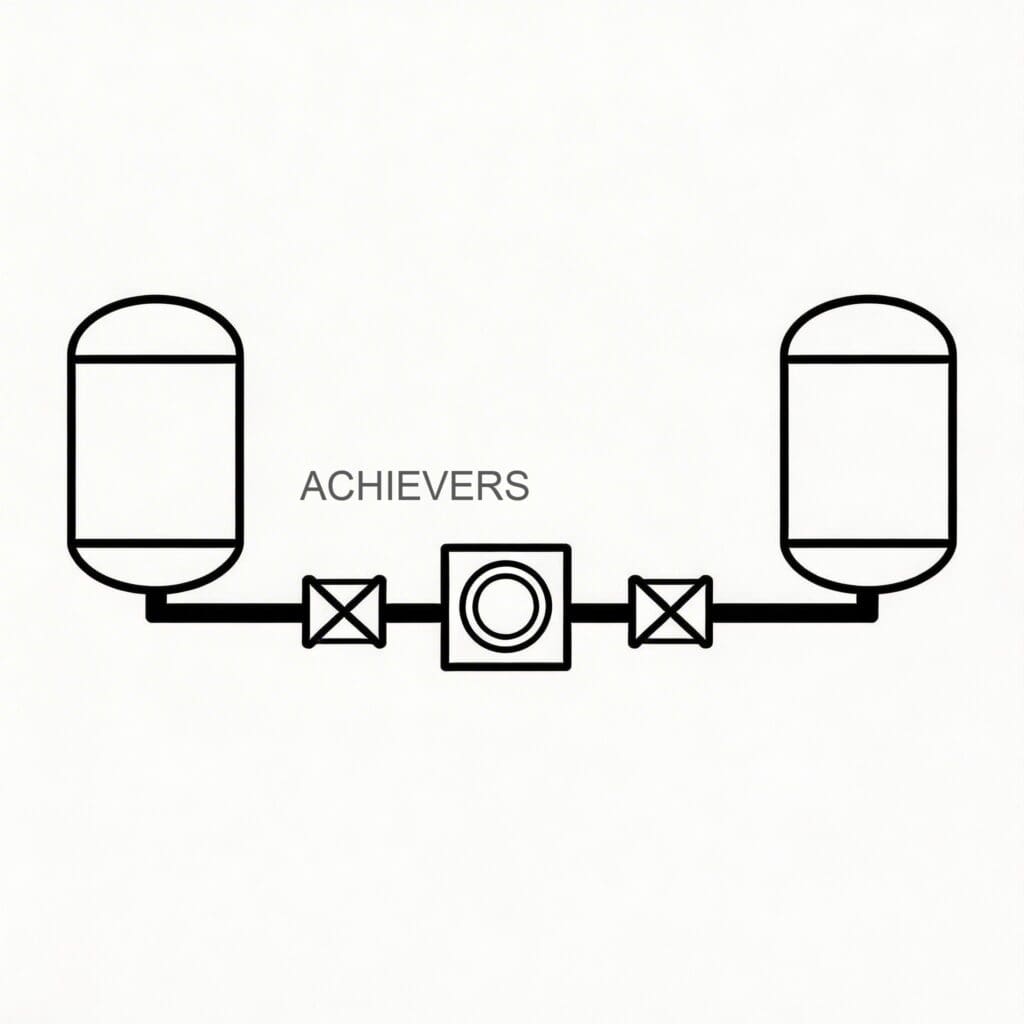
The versatility of Fuel Dispensers allows them to be tailored to specific operational bottlenecks within a plant.
Scenario A: High-Volume Factory Yard & Fleet Fuelling
For a large logistics hub, FMCG manufacturing unit, or transport depot, the primary requirement is speed and reliability. Here, the CE-202 Heavy-Duty model is typically installed permanently near the above-ground storage tank. Operating on a robust 440V AC power supply, it utilizes a high-precision piston meter to deliver up to 60 LPM. This setup allows plant managers to rapidly fuel incoming fleet trucks and heavy material handling equipment, drastically reducing waiting times at the company pump. An optional receipt printer can be added so drivers leave with a physical slip for reconciliation.
Scenario B: DG Set Fuel Replenishment
Power continuity is critical for pharmaceutical and continuous-process chemical plants. These facilities often have multiple large generators. The CE-117 Standard model (running on 220V AC) is ideal here. Instead of laborers carrying 20-liter jerry cans—a massive safety and fire hazard—the dispenser provides a closed, measured loop. The built-in filtration is especially crucial here, as stationary DG set diesel can sometimes accumulate sludge over time. The dispenser ensures clean fuel enters the generator's day tank, and the cumulative totalizer gives the maintenance head exact data to calculate the power-generation-to-fuel ratio.
Scenario C: Remote Mining & Construction Sites
In open-cast mines or highway construction projects, grid power is non-existent, and heavy earth-moving machinery (HEMM) cannot drive back to a central camp just to refuel. For this application, operators mount 12V or 24V DC configurations directly onto a mobile bowser. Powered by the truck's own battery, this setup functions as a highly accurate Mobile Diesel Dispenser. It can traverse rough terrain, dispensing fuel directly into excavators and loaders, with the auto-shutoff nozzle preventing spills on uneven ground.
Common Mistake to Avoid
Many plant managers try to save costs by installing a basic water pump coupled with a cheap agricultural flow indicator. Diesel has a lower viscosity and different lubrication properties than water. Using incompatible seals and uncalibrated meters leads to rapid seal degradation, internal leakage, and meter bypass. You end up with fuel leaking into the yard and accounting errors that cost 10x more than the price of a proper, commercial-grade dispensing unit.
4. Compliance, Accuracy, and Certification Requirements
Procuring equipment for Indian industrial facilities requires strict adherence to regulatory standards. Fluid management is heavily scrutinized during annual financial audits and safety inspections.
Legal Metrology Act (Weights & Measures)
In India, any instrument used for commercial measurement must comply with the Legal Metrology Act. Even if you are only issuing fuel internally (captive consumption), having a Legal Metrology Approved unit ensures that your internal accounting—calculating the cost of goods manufactured—is based on legally valid data. Achievers' equipment is certified by the Govt. of India, giving procurement heads and internal auditors absolute confidence in the numbers on the display.
Petroleum and Explosives Safety Organization (PESO)
If your dispensing system is located in a hazardous zone (such as near petrochemical processing lines), standard electrical enclosures pose a spark risk. For these environments, custom units featuring flameproof (FLP) motors and enclosures are mandatory. Specifying your exact hazardous area classification during procurement ensures the unit meets stringent PESO guidelines for explosive atmospheres.
Measurement Repeatability
Accuracy (±0.5%) is how close the meter's reading is to the true volume. Repeatability (±0.1%) is the meter's ability to deliver exactly the same measurement under identical conditions over and over. High repeatability means you can confidently calibrate the unit once, knowing it will not drift over thousands of liters, preventing the common "end-of-month shrinkage" mystery.
5. ROI and Operational Benefits
Investing in professional dispensing equipment worth between ₹44,000 and ₹1,50,000 is an operational decision that pays for itself rapidly.
| Operational Benefit | Typical Improvement | Indian Industry Context |
| :— | :— | :— |
| Loss Prevention | 2% to 4% reduction in unaccounted diesel | Eliminates manual dipstick rounding errors and deters internal pilferage, saving thousands of rupees per week. |
| Equipment Uptime | 15% reduction in fuel-related engine faults | The large-capacity filter catches tanker rust and monsoon moisture before it destroys expensive common-rail diesel injectors. |
| Labor Efficiency | 50% faster fueling times | Flow rates up to 60 LPM (or 200 LPM custom) mean drivers spend less time idling at the pump and more time working. |
| Environmental Safety | Near 100% elimination of overfills | The auto shut-off nozzle prevents diesel from pooling in the yard, avoiding soil contamination and fire hazards. |
| Audit Reconciliation | Zero manual calculation errors | Digital batch totals eliminate messy, grease-stained logbooks, allowing seamless data entry into plant ERP systems. |
6. Standard Operating Procedure for Internal Fuel Issuing
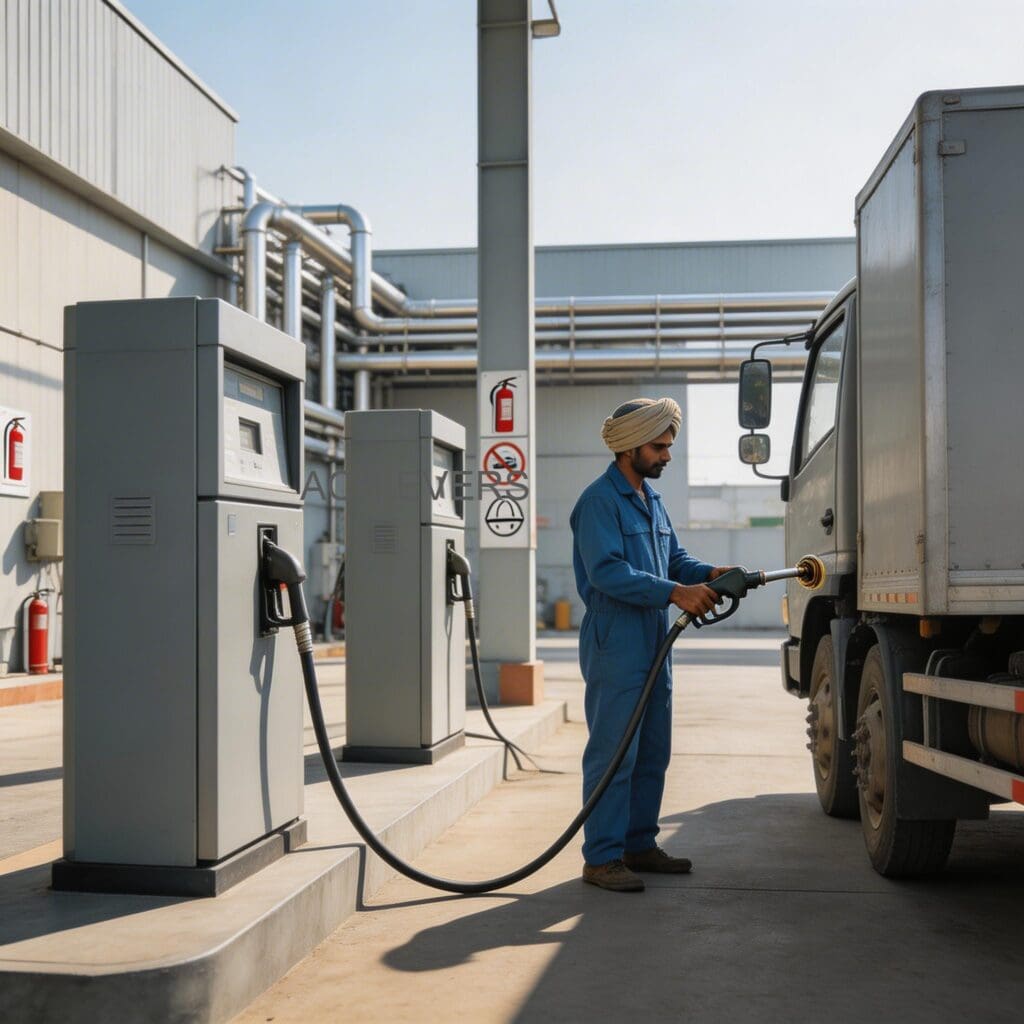
To fully realize the ROI of your dispensing equipment, the physical hardware must be paired with strict procedural discipline. Plant managers should implement the following SOP for all diesel transfers:
- Pre-Authorization Check: Before fueling, the operator must verify the vehicle or DG set requesting fuel against the daily authorized consumption log.
- Meter Reset: The operator manually resets the batch totalizer on the digital display to zero before engaging the pump to ensure transparency.
- Secure Dispensing: The delivery hose is uncoiled fully to prevent kinks, and the auto shut-off nozzle is inserted completely into the recipient tank.
- Supervised Transfer: The operator activates the self-priming pump and monitors the fueling. Even with an auto shut-off feature, the operator must remain at the nozzle until it clicks off.
- Data Logging: Once fueling is complete, the exact batch volume is recorded in the physical log or digital ERP, cross-referenced against the specific vehicle ID or generator number.
- Cumulative Verification: At the end of each shift, the shift manager records the lifetime cumulative totalizer reading. The difference between the start-of-shift and end-of-shift cumulative numbers must exactly match the sum of all individual batch logs.
7. Selection Checklist for This Industry
Do not buy a dispensing unit based solely on price. When making a procurement decision for a heavy-duty industrial application, use this checklist to ensure you specify exactly what your site needs:
- Fluid Type: Confirm if you are pumping standard diesel, biodiesel, kerosene, or specialized oils. (For specialized oils, a dedicated Diesel Flow Meter setup might be required).
- Required Flow Rate: Standard operations do well with 60 LPM. For heavy mining trucks, specify custom high-flow models up to 200 LPM.
- Power Availability: Determine if the installation site has reliable 220V AC, requires 440V AC heavy-duty motors, or needs 12V/24V DC for mobile bowser mounting.
- Tank Setup (Suction Head): Detail whether you are pulling from a deep underground tank or a gravity-fed above-ground tank so the manufacturer can size the self-priming pump appropriately.
- Hose Length Requirements: The standard is a 4-meter rubber hose with brass fittings. If your yard layout requires fueling large vehicles from a distance, specify a longer, reinforced hose.
- Environmental Protection: If the unit is exposed to open monsoon rain or heavy dust, ensure the powder-coated enclosure is fully weather-sealed.
- Hazardous Area Classification: If installed in a chemical or pharma plant, strictly specify if Flameproof (FLP) motors are required.
- Data Outputs: Decide if a simple digital display is enough, or if you need optional features like a preset batch controller or a receipt printer for driver handovers.
FAQ
Q: How often does the internal filter need to be cleaned or replaced?
A: For typical Indian site conditions, we recommend inspecting and cleaning the built-in large-capacity filter every 3 to 4 months. If your bulk diesel supplier frequently delivers contaminated fuel, monthly inspection will prevent flow restriction and protect the flow meter.
Q: Can this equipment handle biodiesel and kerosene?
A: Yes, our standard units are fully compatible with diesel, biodiesel blends, and kerosene. However, if you plan to pump highly viscous liquids like lube oil or corrosive chemicals, please inform us so we can change the internal seals and specify a different meter type.
Q: Why do I need a Legal Metrology Approved unit if I am only using it for my own internal DG sets?
A: Even for captive use, internal financial audits require proof of consumption to calculate operational costs accurately. A certified unit guarantees your flow meter is not under-reporting or over-reporting, giving your accounting department legally valid data.
Q: What happens if there is a power cut mid-dispensing?
A: The digital display retains the current batch memory. Once power is restored, the display will show exactly how much fuel was dispensed before the outage, allowing you to resume seamlessly without losing your count.
Q: Can the pump draw fuel directly from an underground storage tank (UGT)?
A: Absolutely. The dispensing units are equipped with a high-quality self-priming vane or gear pump capable of establishing suction from underground tanks without the need for manual priming or foot valves.
Q: What is the typical lifespan of the equipment in a factory setting?
A: Manufactured in Ahmedabad with heavy-duty steel enclosures and industrial-grade components, these units routinely last 7 to 10+ years with basic maintenance. They come with a 6-month standard warranty, and full spare parts support is available across India.
Q: Can we restrict who is allowed to dispense fuel?
A: Standard units operate via manual switch control. However, we can customize units with preset batch capabilities. If you require advanced access control, the system can be integrated with external fleet management or RFID controllers.
Ready to stop losing money on unaccounted diesel and secure your plant's fluid inventory? Contact the technical team at Achievers Pumps and Valves today to request a quote. Please share your required flow rate, tank setup, and site conditions (Standard or Flameproof) so our engineers can configure the exact dispensing solution for your facility.
Call or WhatsApp: +91-9974192731 | Email: sales@chintanengineers.in