Every minute a heavy excavator or commercial fleet vehicle sits idle waiting for a fuel tanker is a direct loss to your operational profitability. In Indian construction sites, mining pits, and logistics hubs, fueling delays and unchecked diesel pilferage are silent killers of project margins. B2B operators often rely on inefficient, manual drum-and-pump methods that lead to spills, inaccurate accounting, and contaminated fuel entering expensive engine blocks.
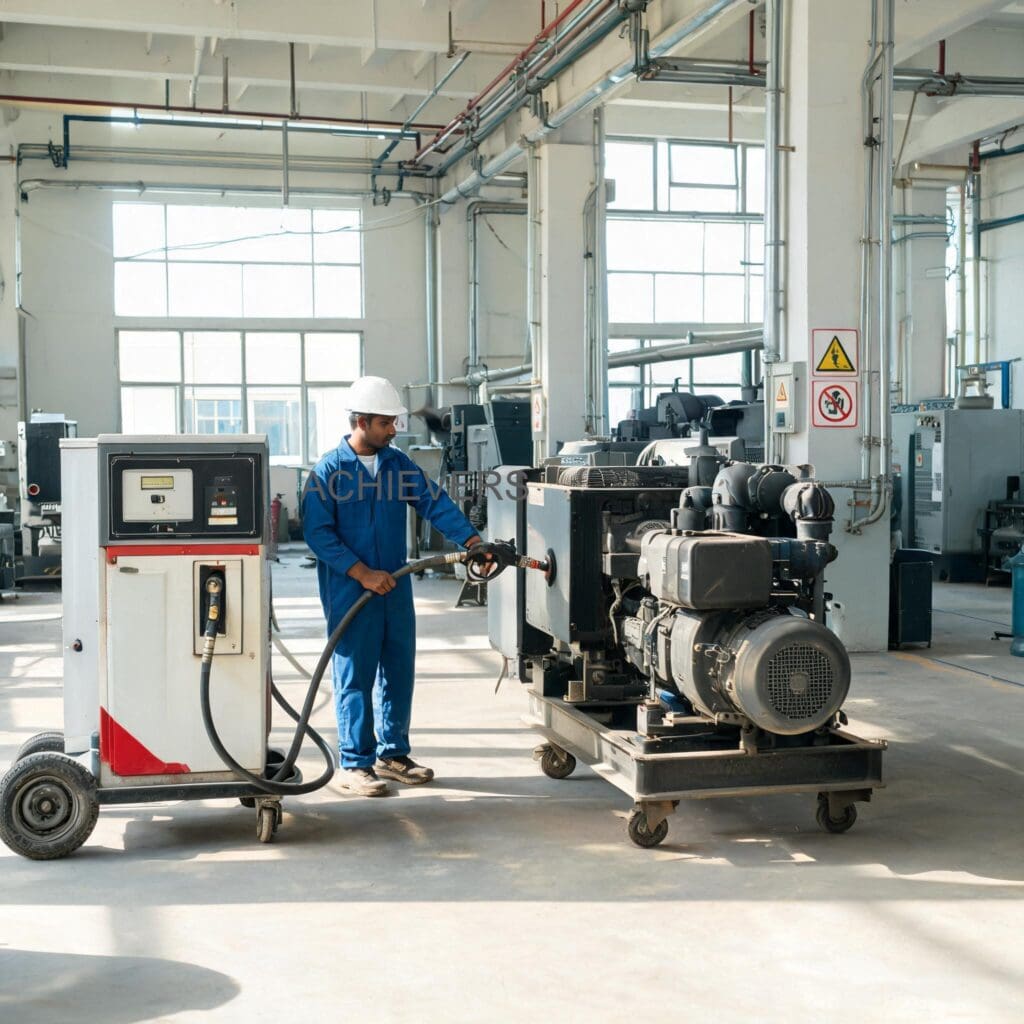
Moving to a Mobile Diesel Dispenser solves these bottlenecks by bringing the "petrol pump" directly to the asset. By integrating a transfer pump, calibrated flow meter, and delivery nozzle into a single portable unit, these dispensers offer speed, accuracy, and accountability. However, specifying the wrong unit for Indian site conditions—whether undersizing the flow rate, ignoring power supply stability, or neglecting Legal Metrology approval—can quickly turn a productivity investment into a maintenance headache.
Quick ROI Snapshot:
Typical payback period: 6 to 8 months. By eliminating a standard 2-3% manual transfer fuel loss and reducing daily heavy machinery refueling downtime by just 30 minutes, an investment of ₹44,000 to ₹95,000 is rapidly recovered.
This guide details how to correctly size, specify, and procure a mobile dispensing system tailored to B2B fleet operations, earth-moving projects, and industrial setups in India.
1. What Is Mobile Diesel Dispenser and What Does It Do
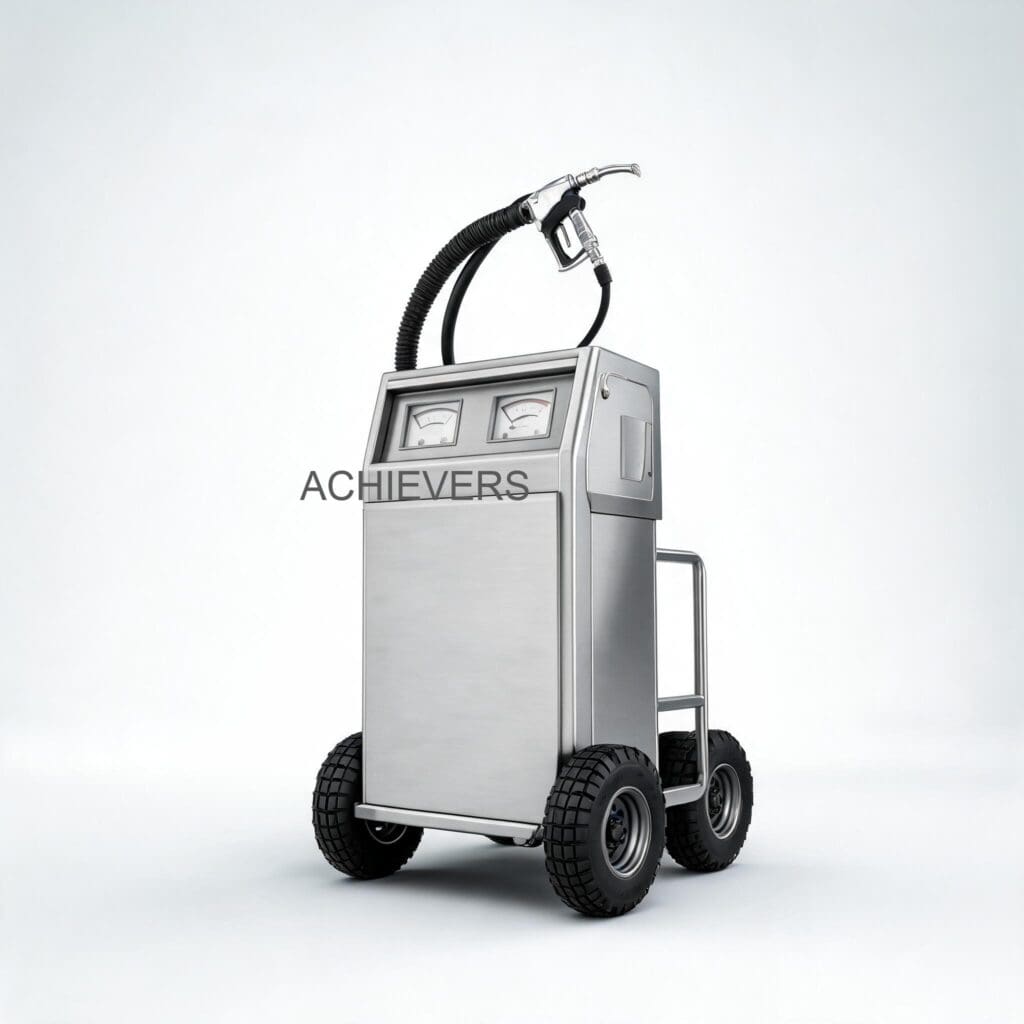
A Mobile Diesel Dispenser is a rugged, self-contained fluid transfer and measurement unit designed specifically for on-site diesel refueling. Unlike stationary fuel station pumps, these units are compact enough to be mounted onto utility trucks, towed bowsers, trailers, or stationary skid tanks.
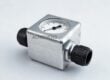
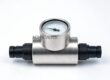
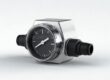
The primary function of the equipment is to transfer diesel fuel from a storage vessel to a vehicle or generator tank while accurately metering the exact volume dispensed. Engineered by Achievers Pumps (a brand of Chintan Engineers, Ahmedabad), these units replace fragmented, piecemeal pumping setups with an integrated system. A standard system consists of a heavy-duty transfer pump, an inline filter to catch debris, a highly accurate digital oval-gear flow meter, a specialized delivery hose, and an automatic shut-off brass nozzle.
This turnkey design allows site operators to achieve fuel station-level accuracy (±0.5%) right at the work face, ensuring every drop of fuel is accounted for via cumulative and resettable batch totalizers.
| Specification | Value | Notes |
| Applicable Media | Diesel, Biodiesel, Kerosene | Not suitable for highly volatile fluids like petrol. |
| Flow Metering | Digital Oval Gear Technology | Ensures high accuracy independent of fluid viscosity changes. |
| Core Accuracy | ±0.5% (Repeatability ±0.1%) | Meets commercial custody transfer standards. |
| Working Pressure | 3 Bar | Sufficient for pushing fuel through standard 4m hoses. |
| Delivery Hose | 4-meter rubber | Specially formulated for diesel; custom lengths available. |
| Dispensing Nozzle | Brass, Auto shut-off | Prevents tank overflow and foaming spills during fast fills. |
| Display | Batch: 0-9,999 L <br> Cumulative: 0-9,999,999 L | Ideal for shift-wise tracking and lifetime volume audits. |
| Compliance | Legal Metrology Approved | Mandatory for official inventory accounting in India. |
2. Key Selection Criteria for Indian Industrial Buyers
Specifying equipment for Indian industrial sites requires accounting for extreme ambient temperatures (often exceeding 45 degrees Celsius), high dust loads, monsoon humidity, and notorious voltage fluctuations.
1. Flow Rate vs. Equipment Duty Cycle
Flow rate determines refueling speed. Pumping 60 LPM is perfectly adequate for agricultural tractors, standard DG sets, or light commercial vehicles. However, if you are refueling 1,000-liter tanks on mining dumpers or large crawler excavators, a 60 LPM pump will take over 15 minutes per machine—causing unacceptable operational delays and driver fatigue. For heavy earth-moving equipment, a high-capacity system delivering up to 200 LPM is strictly required.
2. Power Supply Availability and Voltage Stability
Remote construction and mining sites rarely have stable grid power. You must match the dispenser’s power input to your site's reality. If the dispenser is mounted on a mobile fuel truck, it should operate on the truck’s battery (12V DC or 24V DC). If it is mounted on a stationary yard tank with access to grid or DG power, a 220V AC or 440V AC motor is more robust and offers higher continuous duty cycles. Ensure the electronics can withstand the voltage spikes common in Indian industrial zones.
3. Metering Technology and Core Accuracy
Do not accept basic turbine meters or mechanical nutating discs for rigorous accountability. The gold standard for diesel is the oval gear flow meter. Because oval gear technology measures a precise volumetric cavity of fluid with every rotation, it maintains its ±0.5% accuracy even if the diesel's viscosity changes due to winter temperature drops or biodiesel blending. If your site requires specialized metering apart from the integrated unit, evaluating a standalone Diesel Flow Meter for your bulk receiving lines is also a smart strategy.
4. Legal Metrology and Regulatory Compliance
Under the Indian Legal Metrology Act, any instrument used for commercial transactions, custody transfer, or official inventory audits must be type-approved by the Government of India. Using uncertified dispensing equipment means your fuel records hold no legal weight in supplier disputes or tax audits. Always insist on Legal Metrology Approved models.
5. Environmental Ruggedness and Filtration
Fuel supplied to remote Indian sites is frequently contaminated with dust, rust from old tankers, and water condensation. Pumping this directly into modern Common Rail Direct Injection (CRDI) engines will destroy their injectors. A rugged mobile dispenser must feature inline strainers/filters before the meter to protect both the oval gears from jamming and the end-user's engines. The outer chassis must be heavy-duty steel with a powder-coated finish to resist monsoon rusting.
6. Data Logging and Proof of Delivery
Accountability ends at the point of transfer. If your operators are manually writing down dispensed volumes, you are vulnerable to "ghost fueling" (recording fuel that was never dispensed) or transcription errors. Selecting a compact unit that integrates a built-in receipt printer provides an immediate, unalterable paper trail for the equipment driver and the fuel manager.
3. Model and Variant Comparison
Achievers Pumps manufactures two primary models engineered to cover the spectrum of Indian industrial requirements, from high-volume bulk depots to compact, truck-mounted setups. Prices typically start at ₹44,000 + GST, scaling up based on capacity, power configuration, and add-ons like integrated receipt printers.
| Model | Flow Range | Accuracy & Meter | Power Supply Options | Best For |
| CE-130 High-Capacity | 60 to 200 LPM | ±0.5% (Oval Gear) | 220V AC / 440V AC | Large construction sites, mining operations, mobile bowsers, and bulk fueling depots. |
| CE-204 Compact | 60 LPM | ±0.5% (Oval Gear) | 220V AC / 12V DC / 24V DC | Smaller fleets, B2B transport yards, DG set refueling, and tight-space skid mounting. |
| CE-204 with Printer | 60 LPM | ±0.5% (Oval Gear) | 220V AC / 12V DC / 24V DC | Operations requiring immediate printed proof-of-delivery (Priced at ₹95,000 + GST). |
| Custom Builds | As specified | ±0.5% | AC or DC | Specialized mountings, custom hose lengths, integrated batch controllers. |
4. Common Mistakes Indian Buyers Make When Choosing
Procurement teams unfamiliar with fluid handling equipment often treat fuel dispensers as generic hardware, leading to costly operational failures.
Common Mistake to Avoid:
Using standard agricultural water pumps or uncalibrated drum pumps for diesel transfer. These units lack the required seals for hydrocarbons, pose massive fire hazards, and provide zero volumetric accuracy, making fuel theft incredibly easy.
Avoid these specific missteps when purchasing your dispensing system:
- Ignoring the Duty Cycle Rating: Running a standard 12V DC compact dispenser continuously for 3 hours to fuel 20 trucks will burn out the motor. DC motors generally have a 30-minute duty cycle. For continuous back-to-back fueling, specify a heavy-duty AC system or consult the manufacturer for continuous-rated models.
- Mismatched Hose Sizing: Buyers often request longer hoses (e.g., 10 to 15 meters) to reach difficult equipment but fail to realize that pushing fluid through a long 1-inch hose creates immense friction drop. This chokes the pump, reduces the flow rate drastically, and overworks the motor. If you need a long hose, the internal diameter of the hose and the pump pressure must be upsized accordingly.
- Bypassing the Auto Shut-Off Nozzle to Save Costs: Opting for a cheaper manual nozzle inevitably leads to fuel overflows. A 60 LPM pump can spill 1 liter of diesel per second if the operator looks away. An auto shut-off nozzle pays for itself the first time it prevents a tank overflow.
- Neglecting Site Power Realities: Specifying a 220V AC pump for a mobile fuel truck means the truck must carry a separate inverter or DG set to run the pump. For vehicle-mounted applications, directly utilizing the vehicle’s 12V or 24V battery system via a DC variant is far more efficient.
- Foregoing Legal Metrology for "Internal Use": Even if you are not selling fuel externally, intra-company billing (e.g., charging fuel costs to specific project cost centers or sub-contractors) requires absolute accuracy to prevent disputes. Uncertified meters drift out of calibration rapidly, destroying your inventory reconciliation.
5. Enquiry Specification Checklist
To get the most accurate technical recommendation and pricing from the manufacturer, ensure your RFQ (Request for Quotation) includes the following exact parameters. Missing details lead to generic quotes and mismatched equipment.
- Required Flow Rate: Specify your target Liters Per Minute (LPM). Do you need 60 LPM for standard fleets, or up to 200 LPM for heavy mining equipment?
- Fluid Type and Properties: Confirm the exact media (Standard Diesel, High-Speed Diesel, Biodiesel blends, or Kerosene). Note: These dispensers are not rated for explosive fluids like Petrol/Gasoline.
- Power Supply: What power is actively available where the unit will be mounted? Specify 12V DC, 24V DC, 220V AC (Single Phase), or 440V AC (Three Phase).
- Mounting Configuration: Where will the unit live? Wall-mounted, welded to a stationary storage tank, bolted to a skid frame, or installed on a mobile truck bowser?
- Hose Length Requirement: The standard is 4 meters. If your site requires a 6-meter or 8-meter reach to fuel tall equipment, state this clearly so pump pressure can be verified.
- Display and Data Tracking: Do you need standard digital readouts (Resettable Batch + Cumulative), or do you require advanced integrations like the CE-204’s receipt printer?
- Inlet/Outlet Sizing: Specify if you have existing pipework the dispenser must mate with (typically 25 mm up to 50 mm).
- Budgetary Scope and Certifications: Confirm that you require Legal Metrology Approval, and ensure your budget aligns with industrial-grade equipment (starting around ₹44,000 + GST).
FAQ
Q: Is Legal Metrology approval really mandatory if I am only fueling my own company's vehicles?
A: While strictly legally mandated for commercial sale (custody transfer), it is highly recommended for internal use as well. Approved meters guarantee a tested accuracy of ±0.5%. Without it, internal project audits, inventory reconciliation, and subcontractor billing become a nightmare due to meter drift.
Q: Can a 12V or 24V DC mobile dispenser drain my truck’s battery?
A: Yes, if used excessively while the vehicle engine is off. It is standard practice to keep the transport vehicle's engine idling while operating the DC fuel dispenser to ensure the alternator keeps the battery charged during heavy dispensing cycles.
Q: What is the maintenance interval for the oval gear flow meter inside the dispenser?
A: Oval gear meters are incredibly robust because they have only two moving parts. However, in dusty Indian site conditions, the inline Y-strainer or filter should be checked and cleaned monthly. The meter itself requires periodic calibration checks every 6 to 12 months to maintain its ±0.5% accuracy.
Q: Will an auto shut-off nozzle work if I am dispensing fuel at a very low flow rate?
A: Auto shut-off nozzles rely on back-pressure and fluid velocity to trigger the shut-off mechanism. If you are trickling fuel at less than 15-20 LPM through a high-capacity nozzle, the auto-stop sensor may not trigger reliably. Always match the nozzle rating to your operational flow rate.
Q: What justifies the price difference between a ₹44,000 standard unit and the ₹95,000 CE-204 model?
A: The premium models include high-value peripherals critical for accountability, primarily the integrated receipt printer. Furthermore, price scales with flow capacity (a 200 LPM pump requires a much larger motor and heavier hydraulics than a 60 LPM pump) and specific DC power conversions.
Q: Can I use this dispenser for lubricating oils or petrol?
A: No. Petrol requires completely different explosion-proof (PESO approved) motors and static-dissipating components. Highly viscous lubricating oils require different pump clearances. If you need to meter oils, you should look at dedicated Oil Flow Meters designed for higher viscosities.
Q: Do Achievers Pumps provide local after-sales support and warranties in India?
A: Yes. Manufactured directly in Ahmedabad by Chintan Engineers, the units come with a 6-month standard warranty, extended options, and readily available in-house spare parts. Field service is available across India, preventing the long downtime associated with imported units.
Ready to eliminate fuel pilferage and speed up your site operations? Contact the engineering team at Achievers Pumps with your required flow rate, available power supply, and site conditions. Call +91-9974192731 or email sales@chintanengineers.in to get a customized quote for your operation today.