For industrial fleet operators, mining site managers, and construction procurement teams, decentralized refuelling is a logistical necessity. Bringing heavy machinery back to a fixed refuelling depot wastes billable operational hours, burns unnecessary transit fuel, and increases wear and tear on tracked or specialized vehicles. However, managing fuel at the point of use introduces its own severe risks: fuel shrinkage, contamination, inaccurate batching, and environmental spills.
Deploying a Mobile Diesel Dispenser changes this dynamic. By bringing metered, filtered, and controlled fluid transfer directly to the work face, operations managers can tightly control their highest recurring operational expense: diesel.
This technical guide breaks down the Total Cost of Ownership (TCO) and return on investment (ROI) of upgrading your on-site fuel transfer infrastructure. We will quantify exact savings in fuel loss control, equipment uptime, and administrative efficiency so you can justify the necessary capital expenditure.
Quick ROI Snapshot
- Typical payback period: 4 to 8 months.
- Primary financial drivers: Elimination of 2–4% daily fuel shrinkage, recovery of 1–2 hours of machine transit time per vehicle per week, and prevention of premature injector failures through point-of-use filtration.
- Asset lifespan: 5–10 years with standard preventative maintenance on vanes, seals, and filters.
1. Product Overview and Cost Context
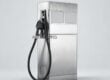
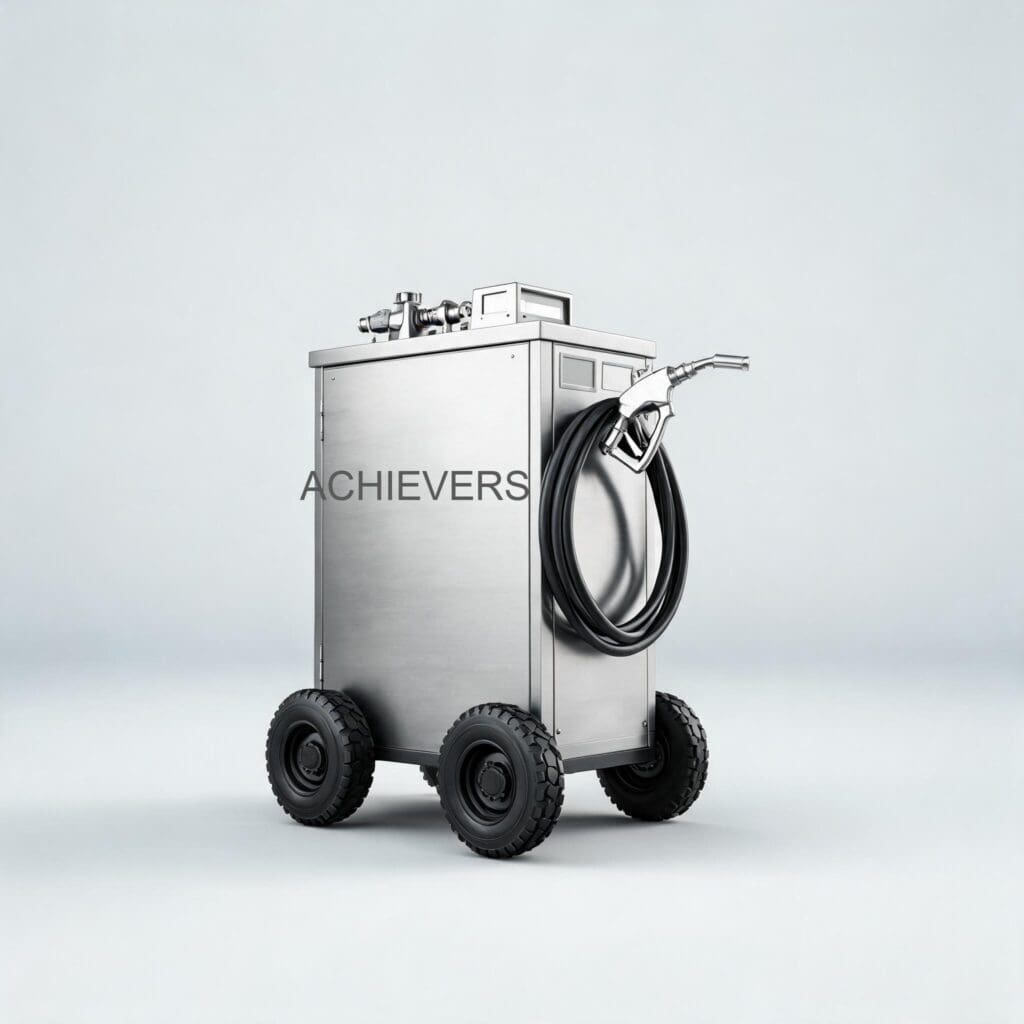
A Mobile Diesel Dispenser is a fully integrated, self-contained fluid transfer unit engineered to be mounted on service trucks, towable bowsers, or portable skid tanks. Unlike basic agricultural transfer pumps, industrial dispensers are precision instruments designed for heavy-duty commercial applications.
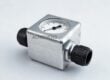
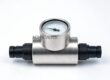
The core assembly integrates a high-flow transfer pump, a highly accurate positive displacement flow meter (typically oval gear), high-capacity inline filtration, delivery hosing, and an automatic shut-off nozzle. The primary objective of this unit is to act as a mobile fuel station, dispensing diesel or biodiesel to remote assets with the exact same metrological accuracy you would expect from a commercial highway fuel depot.
When evaluating the cost of these systems, the upfront purchase price is only a fraction of the financial picture. The true value lies in the accuracy of the oval-gear meter (typically achieving an accuracy of +/- 0.5% or better). In high-volume operations, an inaccuracy of just 1% on unmetered gravity-fed bowsers can result in thousands of dollars of untracked fuel losses annually.
2. Total Cost of Ownership Breakdown
To properly budget for on-site fluid transfer, procurement teams must look past the initial capital expenditure and evaluate the lifetime operational costs. The following table outlines a standard TCO framework for an industrial-grade mobile dispensing unit over a standard 5-year operational lifecycle.
| Cost Component | Typical Range (Relative %) | Frequency | Notes |
| — | — | — | — |
| Purchase Price (CapEx) | 15% – 20% of TCO | One-time | Covers the base unit (pump, meter, hose, nozzle, chassis). High-flow units (200 LPM) sit at the higher end of this range. |
| Installation & Commissioning | 2% – 5% of TCO | One-time | Labour and materials for mounting the unit to a truck chassis or bowser, wiring to 12V/24V vehicle batteries or AC generators. |
| Initial Metrology Calibration | 1% – 2% of TCO | One-time | Third-party or regulatory certification (Weights & Measures approval) to validate the +/- 0.5% accuracy before field deployment. |
| Consumables (Filters & Hoses) | 10% – 15% of TCO | Recurring (Bi-annual) | Regular replacement of inline particulate/water filters and 4m rubber delivery hoses subjected to UV and physical abrasion. |
| Annual Maintenance & Spares | 15% – 20% of TCO | Recurring (Annual) | Preventative replacement of pump vanes, internal seals, auto shut-off nozzle mechanisms, and digital display battery maintenance. |
| Energy Consumption | 1% – 3% of TCO | Recurring (Continuous) | Power drawn from the host vehicle's alternator (DC) or on-site generators (AC). Negligible compared to fluid costs. |
| Cost of Downtime (Unplanned) | 20% – 30% of TCO | Variable | The financial impact of a dispenser failing, forcing heavy machinery to stop working due to fuel starvation. Minimized by robust OEM spares. |
| End-of-Life Replacement | 10% – 15% of TCO | Every 5–7 years | Residual salvage value is low. Replacement is typically required due to general operational fatigue in harsh off-road environments. |
3. ROI Calculation: Real-World Global Example
To justify the upgrade from manual drums, gravity bowsers, or unmetered transfer pumps, you must build a mathematical ROI model based on site-specific variables. The following 8-step calculation models a mid-sized earthmoving contractor with 15 heavy machines.
- Define the Operational Baseline: The site operates 15 heavy assets (excavators, loaders, dozers). Combined, the fleet consumes 3,000 liters of diesel per day.
- Calculate Transit Time Cost: Currently, assets must drive 15 minutes each way to a centralized fuel depot. This consumes 30 minutes of non-productive time per machine, per day. Across 15 machines, that equals 7.5 hours of lost production daily. At a conservative machine billing rate of $100/hour, downtime costs $750 per day.
- Quantify Fuel Shrinkage and Spillage: Without an automatic shut-off nozzle and a highly accurate batch totalizer, operators overfill tanks and fail to log exact volumes. Standard industry shrinkage for unmetered on-site fuel is 2%. On a 3,000L daily burn, 60 liters are lost daily. At $1.50 per liter, shrinkage costs $90 per day.
- Determine Current Total Daily Loss: Adding the lost production time ($750) and the fuel shrinkage ($90) yields a daily operational loss of $840 due to inefficient fluid transfer.
- Establish the Mobile Solution Cost: The company invests in a heavy-duty Mobile Diesel Dispenser (e.g., a CE-130 model) capable of 60-200 LPM. Factoring in the unit, vehicle mounting, wiring, and initial calibration, the total CapEx is approximately $3,500.
- Calculate the New Operational Reality: The mobile dispenser travels to the machines. Transit downtime is reduced from 30 minutes to 0 minutes per machine. The auto shut-off nozzle and +/- 0.5% oval gear meter eliminate spillage and track every drop, reducing shrinkage from 2% down to 0.5%.
- Calculate the Daily Savings: Production time recovered: $750/day. Shrinkage recovered: $67.50/day (45 liters saved). Total daily savings equals $817.50.
- Compute the Payback Period: Divide the total investment ($3,500) by the daily savings ($817.50). The simple payback period is exactly 4.28 working days. Even if we strictly only look at fuel shrinkage (saving $67.50/day) and ignore machine downtime, the payback is reached in 52 days.
Common Mistake to Avoid
Upgrading your transfer pump but continuing to use a basic mechanical turbine meter instead of a positive displacement (PD) meter. Turbine meters are highly sensitive to changes in fluid viscosity and flow rates, leading to inaccurate fleet data. Always pair a mobile fuel pump with an oval-gear Fuel Flow Meter to guarantee +/- 0.5% accuracy regardless of temperature fluctuations or pump RPM.
4. Cost Comparison: Available Approaches
Plant managers generally choose between four methodologies for remote fueling. Understanding the varying levels of accuracy, upfront cost, and long-term viability is critical for making an informed procurement decision.
| Refuelling Approach | Upfront Cost Profile | Annual Operating Cost | Flow Meter Accuracy | Reliability & Contamination Risk | Best For |
| — | — | — | — | — | — |
| Manual Buckets & Drums | Extremely Low | Exorbitant (Labour + Spills) | None (Guesswork) | High Risk (Dust and water ingress during pouring) | Emergency backup only; micro-contractors |
| Gravity-Fed Unmetered Bowser | Low | High (Theft + Overfilling) | Poor (Visual tank gauges) | Medium Risk (No active inline filtration) | Agricultural fields with 1-2 tractors |
| Fixed Central Fuel Depot | Very High | Medium (High machine transit cost) | Excellent (+/- 0.2%) | Low Risk (Heavy commercial filtration systems) | Highway fleets, buses returning to a central yard |
| Mobile Diesel Dispenser | Medium | Low (Maximized uptime) | Very Good (+/- 0.5%) | Low Risk (Inline particulate filters, sealed delivery) | Construction, open-pit mining, forestry, remote power gen |
5. Hidden Costs to Budget For
When building a business case for a Mobile Diesel Dispenser, ensure your TCO model accounts for these six commonly overlooked site realities:
- Power Conditioning and Voltage Drops: For 12V and 24V DC mobile units mounted on trucks, voltage drops over long battery cables will overheat the pump motor. You must budget for heavy-gauge marine wiring and proper circuit breakers to ensure the pump receives stable power.
- Access to Metrology Calibration: Over thousands of operating hours, internal meter gears experience micro-wear. Budget for annual third-party recalibration to maintain legal weights and measures compliance and ensure your cumulative totalizer remains accurate.
- Piping and Flange Modifications: Mounting a new dispenser to a legacy bowser tank often requires custom fabrication. Budget for certified welders to adapt standard 25mm–50mm dispenser inlets to your existing tank outlets, ensuring proper suction lift without cavitation.
- Specialized Filtration Upgrades: Off-road diesel is notoriously dirty. Standard particulate filters will clog rapidly. You must budget for high-capacity, water-absorbing inline filters (often up to 10 microns) to protect both the oval gear meter and your heavy machinery's common-rail fuel injectors.
- Operator Training and Accountability: The ROI evaporates if operators bypass the meter or wedge the auto shut-off nozzle open with a block of wood. Budget time for mandatory operator training on proper nozzle handling, hose coiling, and batch resetting procedures.
- Logistics for Wear Components: Vanes in positive displacement transfer pumps wear down over time. Factor in the cost and lead time of keeping a comprehensive OEM spare parts kit (vanes, O-rings, digital display batteries) on the shelf to prevent multi-day downtime.
6. Technical Specifications Justifying the ROI
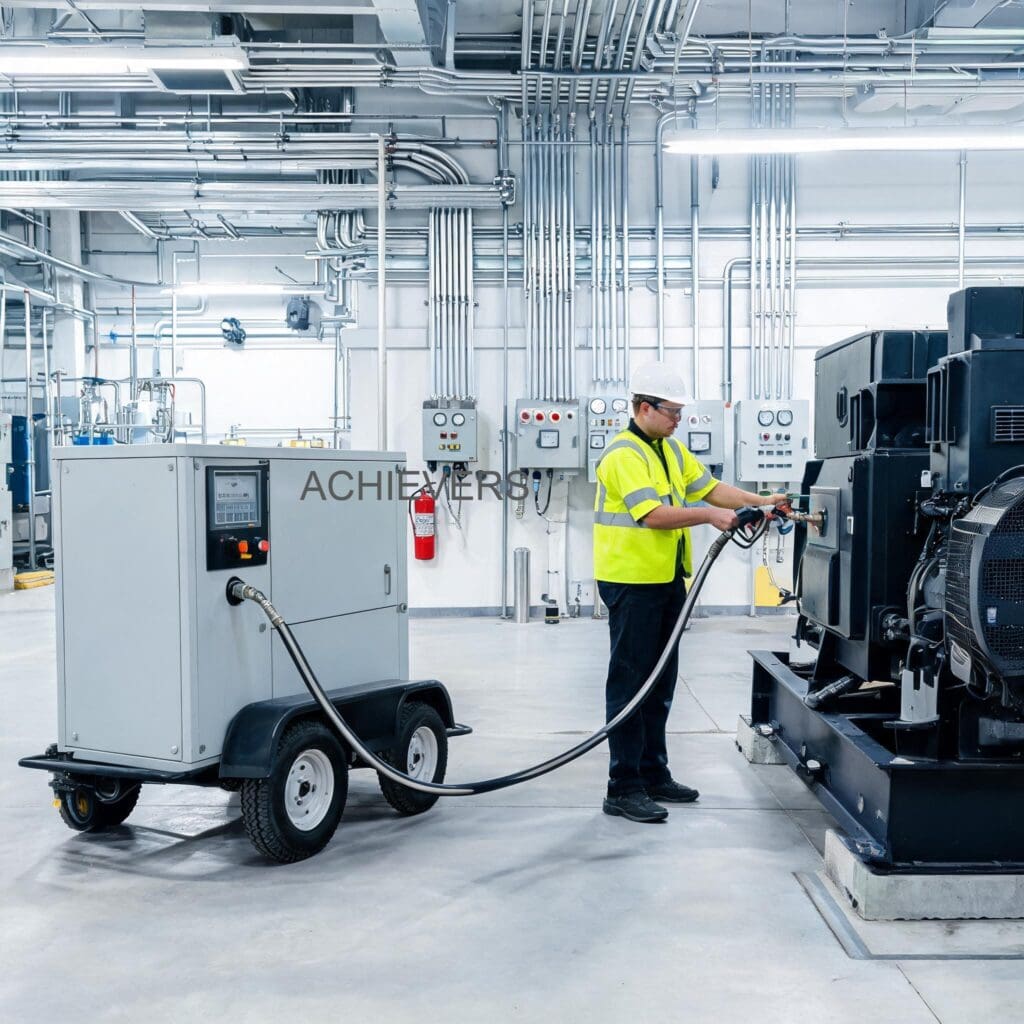
To achieve the financial returns outlined above, the hardware must be robust. Achievers Pumps (manufactured in our state-of-the-art facility) offers units engineered specifically for harsh environments. Below is the technical data separating commercial-grade dispensers from light-duty alternatives.
| Parameter | CE-130 (High Capacity) | CE-204 (Compact Unit) |
| — | — | — |
| Applicable Media | Diesel / Biodiesel / Kerosene | Diesel / Biodiesel / Kerosene |
| Flow Rate Capability | 60–200 LPM (Pump dependent) | 60 LPM |
| Flow Meter Technology | Oval gear (digital, positive displacement) | Oval gear (digital, positive displacement) |
| System Accuracy | ±0.5% | ±0.5% (Repeatability ±0.1%) |
| Maximum Working Pressure | 3 Bar | 3 Bar |
| Power Supply Options | 220V AC / 440V AC (3-Phase) | 220V AC / 12V DC / 24V DC |
| Inlet / Outlet Dimensions | 25–50 mm | 25 mm (1") |
| Hose Assembly | 4 m (Custom lengths available) | 4 m standard |
| Nozzle Type | Auto shut-off, heavy-duty brass | Auto shut-off, heavy-duty brass |
| Batch Counter Limits | 0–9,999 L (Resettable) | 0–9,999 L (Resettable) |
| Cumulative Counter limits | 0–9,999,999 L (Non-resettable) | 0–9,999,999 L (Non-resettable) |
| Metrology Status | Approved for commercial use | Approved for commercial use |
Note: The CE-204 model can be highly customized with optional receipt printers to provide physical, time-stamped proof of fueling transactions for contractors billing clients for fuel usage.
7. How to Justify the Purchase to Management
If you are a site engineer or fleet manager, simply asking procurement for new hardware often results in rejection. You must present a financially sound business case. Follow this six-step procedure to secure budget approval:
- Establish the Baseline Data: For two weeks, document exactly how many hours are spent moving machinery to fuel sources, and audit your bulk tank deliveries against your actual machine consumption to find your "missing" fuel percentage.
- Quantify the Leakage in Currency: Convert those lost hours and missing liters into a monthly dollar value. This is your "Cost of Doing Nothing."
- Select the Right Equipment: Choose the appropriate dispenser model. If you are fueling large haul trucks, specify the CE-130 (up to 200 LPM). If fueling smaller excavators or generators, select the CE-204 (60 LPM, 12V/24V). Request a formal quote.
- Map the Implementation TCO: Add the quote price to the hidden costs discussed in Section 5 (installation, filtration, wiring, annual spares). Create a holistic 3-year cost projection.
- Project the Return on Investment: Use the 8-step formula from Section 3 to prove how quickly the equipment pays for itself. Frame the purchase not as an expense, but as an operational cash-flow optimization tool.
- Highlight the Risk Mitigation Factors: Conclude your proposal by emphasizing the non-tangible benefits: minimized environmental spill risk via auto shut-off nozzles, reduced wear on heavy equipment tracks, and guaranteed compliance with commercial Weights & Measures regulations.
FAQ
Q: Can a mobile dispenser handle extremely dusty or wet mining environments?
A: Yes. Industrial mobile dispensers are housed in heavy-duty, powder-coated steel enclosures. The digital oval-gear flow meters feature high IP (Ingress Protection) ratings. However, for maximum lifespan, we recommend adding a secondary weather canopy if the unit is permanently mounted on an open flatbed.
Q: Do I need to prime the pump every time I start the dispenser?
A: No. The positive displacement rotary vane pumps used in our CE-130 and CE-204 systems are self-priming. They can efficiently draw fluid from the bottom of a bowser tank without requiring manual repriming, provided the suction lines are completely airtight.
Q: Why does the pump automatically shut down occasionally during heavy use?
A: Standard DC transfer pumps usually have a duty cycle (typically 30 minutes on, 30 minutes off) to prevent the electric motor from overheating. If you require continuous, non-stop transfer for hours at a time, you must specify a continuous-duty AC pump or a heavy-duty industrial DC variant.
Q: Will these units work with thick, heavy oils or just diesel?
A: Mobile Diesel Dispensers are calibrated specifically for the viscosity of diesel, biodiesel, and kerosene. Pumping highly viscous fluids like gear oil or hydraulic fluid requires different pump clearances and lower RPMs. For heavy oils, you must configure a dedicated pumping skid paired with an industrial Diesel Flow Meter calibrated for high viscosity.
Q: How often do I need to replace the inline filters?
A: Filter life depends entirely on the cleanliness of your bulk fuel supply. As a general rule, particulate/water filters should be replaced every 6 months, or immediately if operators notice a sudden drop in the dispensing flow rate (LPM), which indicates the filter media is saturated.
Q: What is the difference between the batch counter and the cumulative totalizer?
A: The batch counter tracks a single refueling event (e.g., dispensing 350L into an excavator) and can be reset to zero by the operator. The cumulative totalizer tracks every drop of fuel that has ever passed through the meter (up to 9,999,999 L) and cannot be manually reset, serving as an anti-theft auditing tool for management.
Q: Are these dispensers ATEX approved for highly explosive environments?
A: Standard diesel dispensers are designed for standard industrial applications. While diesel is combustible, it does not typically require explosive-proof (ATEX/UL hazardous area) ratings like gasoline or aviation fuel. If you are operating in a classified hazardous zone, you must request specifically certified ATEX motors and intrinsically safe electronics.
Stop losing your operating budget to unmetered fuel shrinkage and unnecessary machine downtime. For a consultative assessment of your fleet size, site conditions, and flow rate requirements, contact our engineering team today to configure a Mobile Diesel Dispenser tailored directly to your fluid handling operations.